

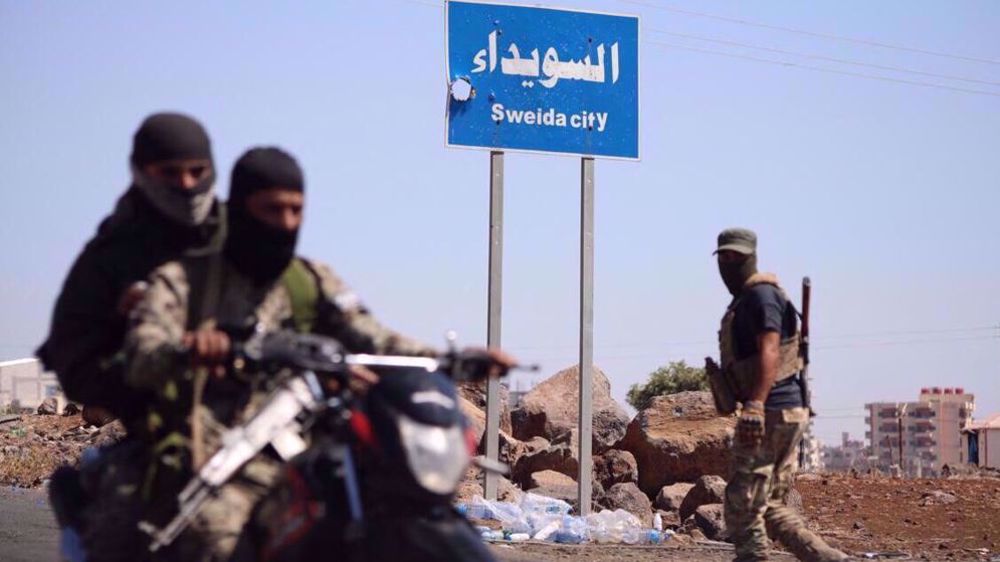
Heavy clashes have broken out between Syrian interim regime forces and Druze armed groups in the southern province of Suwayda, as tensions continue to simmer in the volatile region despite a ceasefire agreement reached nearly a year ago.
Fighting erupted in the Tal Hadid area west of Sweida city on Friday, with armed groups targeting positions of the so-called internal security forces using heavy machine guns, according to Syrian regime television and security sources cited by Anadolu Agency.
Local media reported casualties on both sides, with social media users circulating footage purportedly showing the destruction of the regime’s military vehicles.
The violence comes just days after Syria's self-appointed president Abu Muhammad al-Jolani completed the formation of the country's first post-Assad parliament, finalizing the names of 70 legislators on July 1 and paving the way for the 210-member assembly to hold its first session on July 6.
The new legislature, tasked with drafting a constitution and amending laws during a 30-month transitional period, has been widely criticized for concentrating power in Jolani’s hands and failing to adequately represent the country's ethnic and religious minorities.
The Sweida province, home to Syria's Druze community, has been a flashpoint since Jolani’s Takfiri-led coalition of the most violent Daesh and al-Qaeda terrorists overthrew Bashar al-Assad in December 2024.
A July 2025 ceasefire halted week-long sectarian violence that left more than 1,700 people dead and forced nearly 200,000 from their homes, according to a UN Commission of Inquiry report.
The violence saw Jolani’s forces and allied tribal fighters commit widespread violations against Druze civilians, followed by retaliatory attacks by Druze armed groups against Bedouin communities.
Since then, armed groups affiliated with Druze leader Sheikh Hikmat al-Hijri have repeatedly targeted regime checkpoints and military positions in recent months.
Among the 70 legislators appointed by Jolani were two representatives from Sweida, including Leith Balous, a Druze warlord widely considered a traitor by Syria's Druze community for siding with regime forces during the July 2025 massacres.
The selection process in Sweida had been indefinitely postponed, with electoral committee head Mohammed Taha al-Ahmad stating it would proceed only when conditions were "appropriate".
Analysts have pointed to Ankara's growing influence over Syria's political transition, noting that former Syrian refugees in Turkey make up a quarter of the parliament's initial 140 members selected last year.
Turkish institutions engaged extensively with Syrian opposition figures who now constitute the vast majority of parliamentarians, according to Türkiye Today.
The new parliament, which includes only 22 women out of 210 members, has been dismissed by critics as a rubber-stamp body designed to serve Jolani’s interests.
"The whole process went without proper consultations with the Syrian public and without a national dialogue; therefore, it was designed to serve one party only," Bassam al-Kuwaiti, leader of the Syrian Liberal Party, told The New Arab.
UN Deputy Special Envoy for Syria Claudio Cordone welcomed the parliament's formation as "an important milestone" while stressing that "the success of the transitional process depends on the meaningful participation of Syrian women and all segments of society".
 This makes it easy to access the Press TV website