European leaders – touchy about Ukraine – cheer US ‘regime change’ war on Venezuela
By Maryam Qarehgozlou
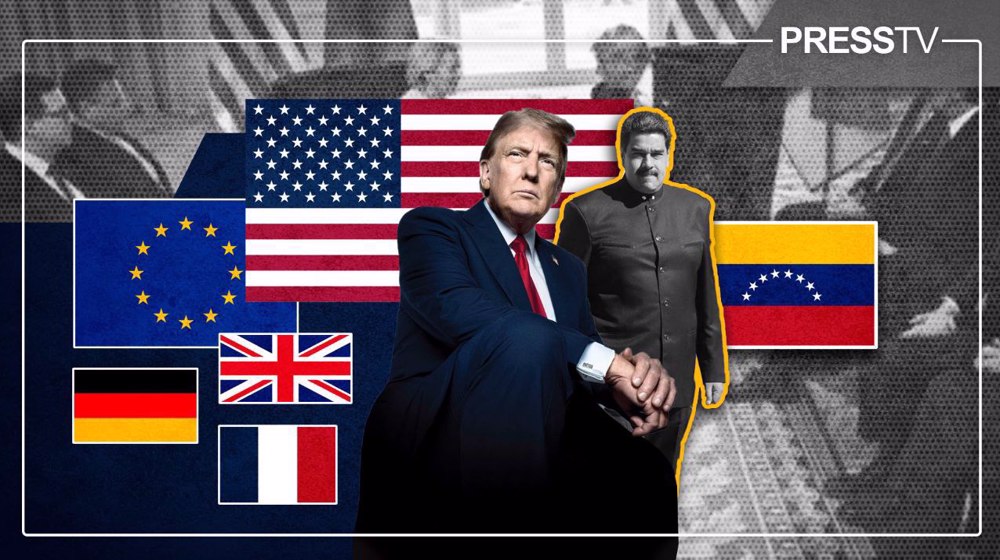
European leaders have rushed to applaud Washington’s latest act of naked imperial aggression against Venezuela, while cloaking their support in deliberately vague language.
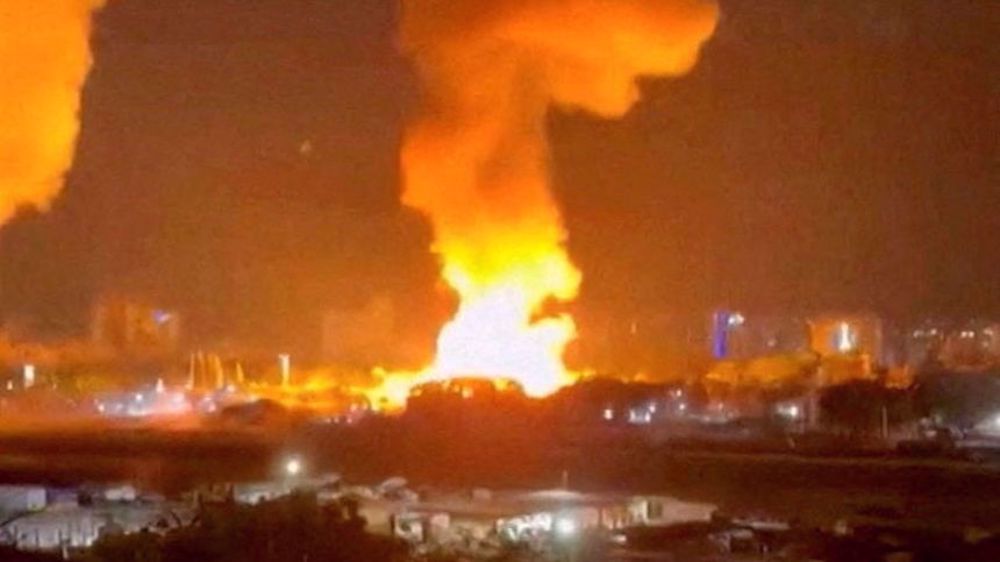
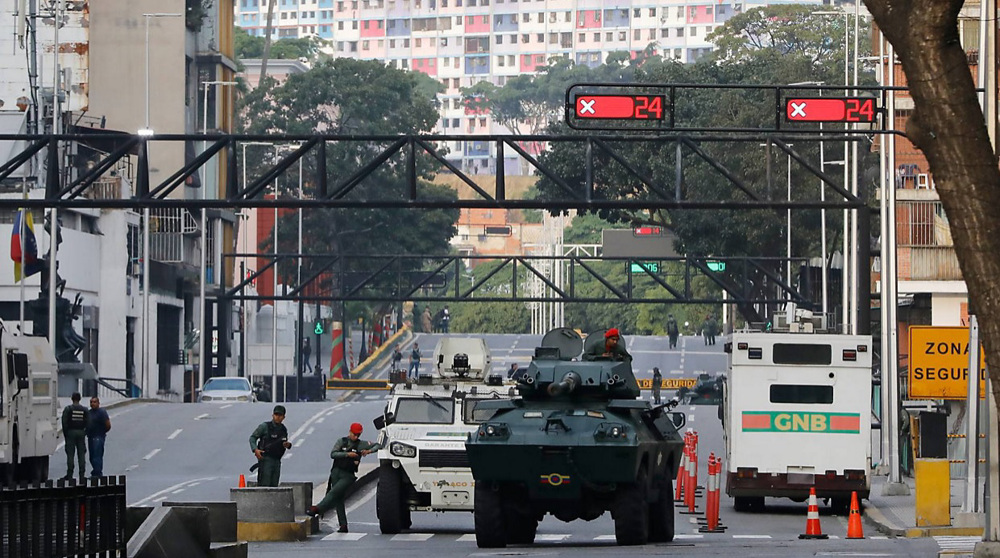
In the early hours of Saturday, American military personnel, led by Delta Force, an elite special forces unit, launched a wave of missile and drone strikes on the Venezuelan capital, Caracas, jolting people awake and forcing them into the streets in a state of panic.
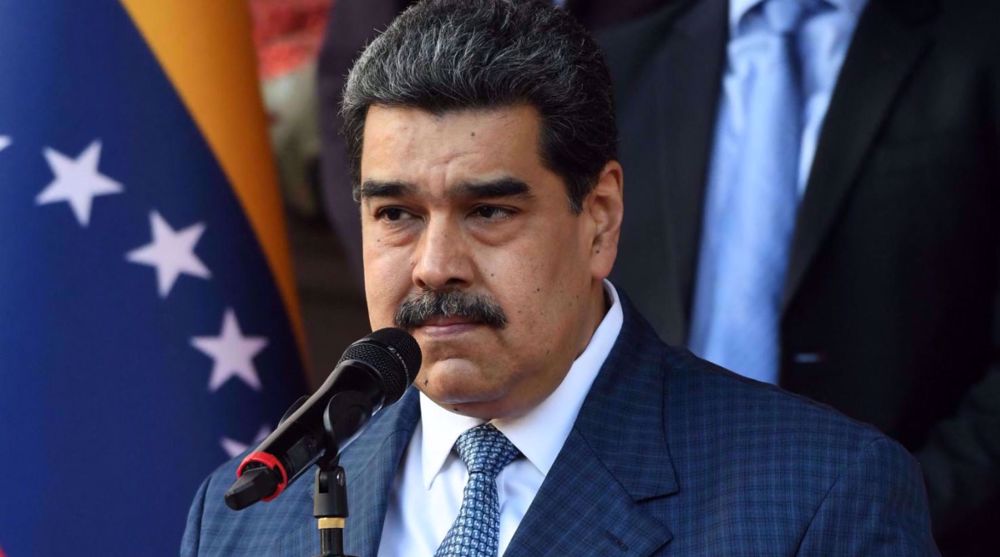
Hours later, US President Donald Trump announced that Venezuelan President Nicolás Maduro and his wife, Cilia Flores, had been “captured” by US forces and airlifted out of the country.
US media outlets subsequently reported that the duo were transferred to the Metropolitan Detention Center in Brooklyn, New York, where Maduro is expected to face charges in a Manhattan federal court – charges that Caracas has long dismissed as politically motivated.
The overnight assault followed months of escalating US pressure, including a buildup of military forces across South America, deadly and indiscriminate strikes on boats in the eastern Pacific and Caribbean, and increasingly explicit threats against Maduro and his democratically-elected government.
Venezuelan authorities repeatedly warned that Washington was pursuing outright “regime change,” with the ultimate objective of seizing control of the country’s vast energy resources.
Those warnings were confirmed almost immediately. On Saturday, Trump openly stated that Washington would take control of the country’s massive oil reserves.
The remark stripped away the last fig leaf from the so-called “war on drugs,” exposing it as a familiar cover for imperial plunder—one enthusiastically endorsed by Europe.
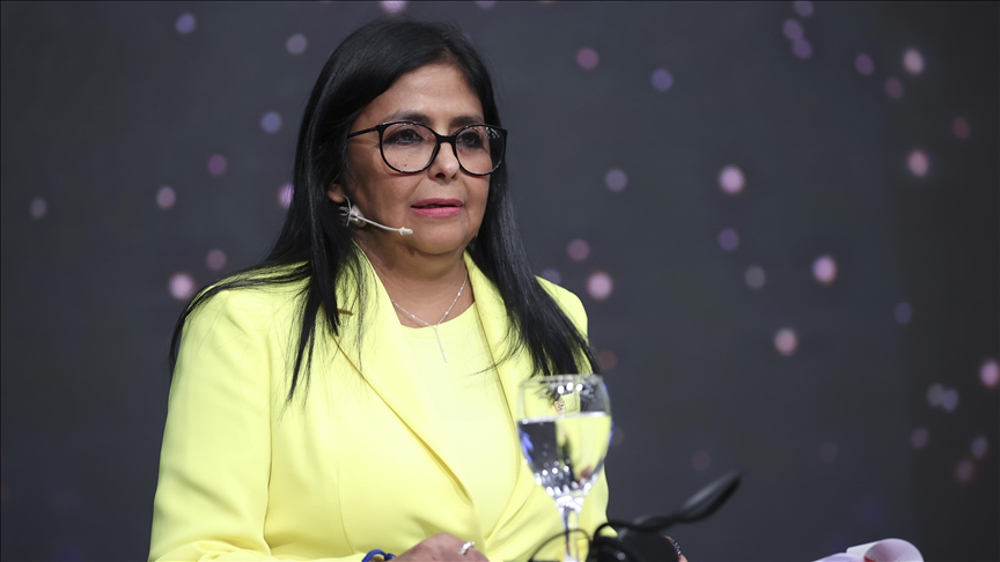
The Venezuelan Supreme Court appointed Vice President Delcy Rodriguez as acting president. This comes after President Nicolas Maduro was abducted in a US attack on the South American country.
— Press TV 🔻 (@PressTV) January 4, 2026
Follow: https://t.co/mLGcUTSA3Q pic.twitter.com/BRO6AjdTFF
In near-unison, European governments welcomed the brazenly illegal US assault and the forceful removal of Venezuela’s elected leader, offering political cover to an attack that trampled international law and state sovereignty.
Their cautious wording showed they knew the move violated the “rules-based order” they constantly preach, yet they chose complicity over principle.
Experts were quick to point out their duplicity and hypocrisy. While these European countries show enthusiasm in condemning Russia’s military operation in Ukraine and warn against Moscow’s plans in the name of sovereignty and international law, they support US aggression when the same norms are shredded in Venezuela.
The timing of the European endorsement of the attack on Venezuela is particularly revealing.
Less than a month ago, the Trump administration’s National Security Strategy, which had reserved some of its harshest language for European countries, openly revived the Monroe Doctrine, a 19th-century imperial policy explicitly aimed at excluding Europe from influence in the Western Hemisphere.
Then, Washington framed Europe as a rival. Now, Brussels and other European capitals are content to play the role of silent partner in the repackaged American imperial project.
That calculation is no accident. With it now clear that the resurrected Monroe Doctrine will not threaten European commercial interests – and will instead facilitate US domination over Latin America’s vast oil wealth – European leaders have fallen in line.
As experts state, principles quickly evaporated once profits were assured.
True colors of US revealed after abduction of Venezuelan President Maduro: Ansarullah https://t.co/oEpuEZeYFp
— Press TV 🔻 (@PressTV) January 4, 2026
How did European leaders react?
European leaders responded to Washington’s military assault on Venezuela with carefully calibrated evasions on international law, while openly celebrating the violent removal of Maduro, exposing their complicity in an illegal US-led “regime-change” operation.
UK Prime Minister Keir Starmer exemplified this posture of deliberate ambiguity. Speaking to the BBC’s Sunday with Laura Kuenssberg, he refused to say whether the US strikes violated international law, insisting he was “waiting to establish all the facts” while claiming he would not “shy away from this,” adding that he was a “lifelong advocate of international law.”
Yet Starmer conspicuously avoided condemning the attacks that have been unequivocally condemned by legal experts and international affairs pundits, stressing instead that Britain was not directly involved and that he had not spoken to Trump.
Any remaining pretense of neutrality collapsed later when he declared on X that the UK “regarded Maduro as an illegitimate president and we shed no tears about the end of his regime,” adding that London would work with Washington toward a “safe and peaceful transition” – language that tacitly endorsed an act of military aggression he declined to judge.
At the European Union level, High Representative for Foreign Affairs and Security Policy Kaja Kallas leaned heavily on procedural language while shielding the US from accountability.
Reiterating that Maduro “lacks legitimacy,” she spoke of a “peaceful transition” and dutifully noted that “under all circumstances, the principles of international law and the UN Charter must be respected.”
Yet her call for “restraint” clearly avoided naming the aggressor, reducing a US missile and drone assault to an abstract concern while prioritizing “the safety of EU citizens,” not Venezuelan citizens or the country’s sovereignty and territorial integrity.
French President Emmanuel Macron dispensed with even symbolic caution, openly celebrating the US aggression against the South American country.
Declaring that Venezuelans “could only rejoice,” Macron announced on X that “the Venezuelan people are today rid of the dictatorship of Nicolas Maduro,” framing foreign military intervention as liberation.
He went a step further, expressing hope that “President Edmundo Gonzalez Urrutia, elected in 2024, will be able to ensure this transition as quickly as possible,” aligning France squarely with Washington’s preferred proxy candidate in Caracas.
That proxy, however, had already collapsed. González – the Western-backed figurehead promoted as Venezuela’s “legitimate leader” after the disrupted 2024 election – had rejected official results and encouraged parallel power structures outside constitutional channels.
Caracas denounced the attempt as an illegal, foreign-sponsored scheme, and Venezuelan institutions dismantled the shadow network for collusion with Washington and its regional allies.
As legal proceedings advanced, González fled the country, leaving behind yet another failed Western regime-change experiment.
✍️ Feature - Nobel 'War' Prize: Machado awarded for advocating US and Israeli military intervention in Venezuela
— Press TV 🔻 (@PressTV) October 11, 2025
By Maryam Qarehgozlouhttps://t.co/VppHdD549T
Italian Prime Minister Giorgia Meloni attempted to reconcile overt support for the US assault with rhetorical opposition to Trump’s “regime change.”
Defending the strikes as legitimate “defense,” she stated that while “external military action is not the way to end totalitarian regimes,” a “defensive intervention against hybrid attacks on its security” was justified – specifically citing “state entities that fuel and promote drug trafficking.”
Her formulation echoed Washington’s long-discredited narcotics narrative, recasting aggression as self-defense while endorsing its outcome.
German Chancellor Friedrich Merz also sought to avoid outright judgment, calling the legality of the US aggression “complex” and asserting that international law “in general must apply.”
He justified Berlin’s stance by claiming Maduro had led Venezuela “into ruin” and that the most recent election was “rigged,” noting Germany had therefore not recognized his presidency, a claim that again substituted political disapproval for a legal assessment of military force.
Greek Prime Minister Kyriakos Mitsotakis dispensed with legal scrutiny altogether, declaring that “now is not the time to comment on the legality of the US actions,” while openly celebrating what he termed “regime change.”
Claiming Maduro’s government had brought “unimaginable sufferings” to Venezuelans, Mitsotakis said, “The end of his regime offers new hope for the country.”
Across Europe, the pattern was unmistakable: vague references to international law, selective outrage, and enthusiastic endorsement of Washington’s objectives.
‘Act of war’: New York Mayor Zohran Mamdani slams US aggression against Venezuela https://t.co/2SkVTnXb0B
— Press TV 🔻 (@PressTV) January 4, 2026

‘Political hypocrisy’
Leaders who routinely invoke sovereignty and the UN Charter to condemn Russia’s military actions in Ukraine abandoned those principles when the violator was the US, revealing that Europe’s commitment to international law remains conditional, selective, and ultimately subordinate to US power.
Russia’s special envoy Kirill Dmitriev openly confronted this double standard after European Commission President Ursula von der Leyen urged a “peaceful and democratic transition” in Venezuela.
Dmitriev contrasted Brussels’ language with its posture on Ukraine, noting that while European leaders frame Russia’s military operation as a breach of international law, a US assault on Venezuela, complete with the abduction of its president, is rebranded as “peaceful and democratic.”
He also directly criticized EU foreign policy chief Kaja Kallas following her claim that “Maduro lacks legitimacy,” sarcastically suggesting that perhaps Washington should invade Greenland next, implying that only then might the EU reconsider its reflexive support for US military actions.
The backlash was not confined to diplomats. Legal and political figures, as well as ordinary users, took to social media to denounce Europe’s political hypocrisy.
Australian barrister, author, and political commentator Gregory Joseph Barns underscored the contradiction in blunt terms.
“The hypocrisy of the West. Condemning Russia for invading Ukraine but allowing the US to ignore international law by invading Venezuela,” he wrote in an X post.
Others highlighted the selective application of legal principles. Social media user Olarte Alexandra warned that silence from EU leadership amounted to endorsement.
“Condemning some invasions while justifying others is political hypocrisy. If international law applies to Ukraine, it must also apply to Venezuela. The silence of @vonderleyen and the @EU_Commission is worrying,” she wrote.
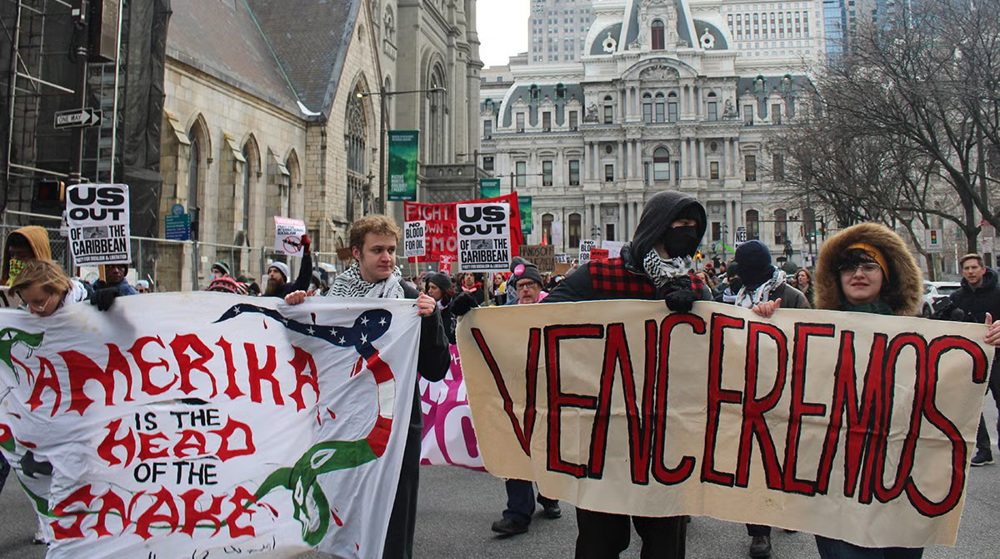
Protests erupt across US over military aggression against Venezuela, kidnapping of Madurohttps://t.co/6IX9dggyKg
— Press TV 🔻 (@PressTV) January 4, 2026
Some commentators pointed to the geopolitical justifications selectively deployed by Western powers. Writing under the handle @CheburekiMan, one user noted the sudden elasticity of Western red lines.
“Weird how it’s suddenly okay for the US to invade Venezuela on the flimsiest pretext, but not okay for Russia to invade Ukraine to stop a hostile military bloc from existentially threatening it,” he wrote.
Geopolitical analyst Eddie Gonzales framed the issue as a moral and strategic contradiction.
“The EU and European leaders are eerily silent on the US’s blatant act of aggression in Venezuela—bombing a sovereign nation and capturing its leader, Maduro. Yet they’ve been screaming about Russia’s full-scale invasion of Ukraine as the ultimate violation of international law. What’s the difference here? Oil, alliances, or just good old hypocrisy?” he wrote.
Maduro’s kidnapping: China says US cannot act as world’s ‘police’ or ‘judge’
Cuba declares national mourning for 32 citizens killed in US raids on Venezuela

After US aggression against Venezuela, Mexico could be next: Report


Iran’s breakthrough oral SMA drug sparks hope for rare disease patients worldwide
VIDEO | Alliance turned battlefield
Venezuela’s Iran embassy: US misjudged Maduro, expected a Noriega, found a Mandela
'Security a red line': Iran vows 'decisive' response to threats
Iran not afraid of enemy, will not submit to US domination: IRGC
Iran foils foreign-linked sedition network, arrests armed suspects
UK acting as US vassal state on Venezuela
VIDEO | US kidnapping of Maduro, and the 'Donroe' Doctrine


 PressTV NEWSLETTER
now
PressTV NEWSLETTER
now

 This makes it easy to access the Press TV website
