US would face defeat in armed conflict with Venezuela - as in 12-day war: Envoy
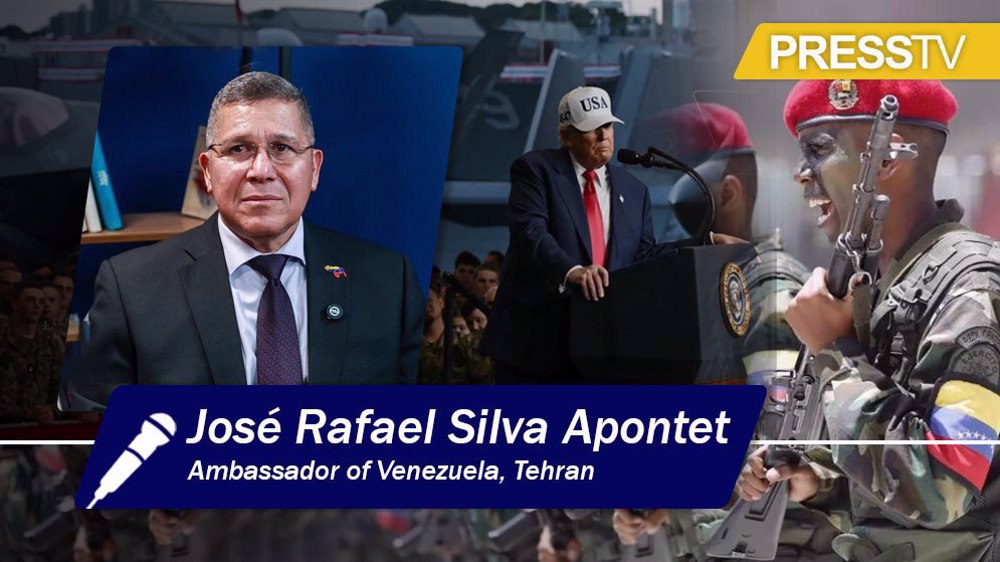
By Farzaneh Ashoorioun
Tensions between the United States and Venezuela continue to escalate amid a growing US military buildup near the South American country and a series of unprovoked attacks on vessels in the Caribbean Sea over recent months.
Most recently, on Wednesday, in yet another brazen act of aggression, US forces hijacked an oil tanker off the coast of Venezuela.
A day later, US President Donald Trump threatened to launch ground attacks on Venezuela, saying it is "going to be starting on land pretty soon.”
The Trump administration has — without presenting any evidence — accused Venezuelan President Nicolás Maduro of supplying drugs to the US that are “poisoning the American people.”
Maduro, speaking on Thursday, said the “mask has fallen,” laying bare the real objective behind the military buildup and repeated attacks on vessels in the region.
“The issue is not drug trafficking. It’s the oil they want to steal,” he said, adding that the imperialists have set their sights on Venezuela’s vast oil and mineral reserves.
Against this backdrop, the Press TV website spoke with Venezuelan Ambassador to Tehran, José Rafael Silva Aponte, about the rapidly unfolding developments in South America, as Trump openly pursues a policy of “regime change” in Caracas.
The following are excerpts from the interview:
Q. What is your analysis of the latest developments in the escalating tensions between Venezuela and the United States, and what are the underlying reasons for US sanctions against Venezuela and other Latin American countries?
A. There is no tension between Venezuela and the United States. What we have here is an aggression, a threat from the government of the United States toward Venezuela, the Caribbean region, and Latin America. And one of the main motives is to carry out a "regime change" and subsequently seize the wealth that Venezuela possesses.
Among these we can mention oil. As is known worldwide, Venezuela has the largest proven oil reserves in the world, as well as the fourth-largest gas reserve, but also gold, diamonds, coltan, rare earths, biodiversity, etc. This is one of the main reasons and it is the reason for the sanctions they have applied—to pressure Venezuela and other countries so that they yield to the demands of the United States.
The most recent event was the act of piracy revealed by the President of the United States himself, when he stated that they had seized an oil tanker off the Venezuelan coast; this is a theft that adds to the one committed with the illegal sale of the Venezuelan company CITGO, a subsidiary of Petróleos de Venezuela Sociedad Anónima (PDVSA).
Venezuela signals unwavering resolve as Caracas embraces a Vietnam-style underground resistance to counter 'American imperial aggression', with military leaders insisting the nation stands unified like a single rifle in defense of its sovereignty. pic.twitter.com/MQpxY0Yre3
— PressTV Extra (@PresstvExtra) December 8, 2025
Q. How does Venezuela interpret these developments within the framework of its foreign policy and its relations with sovereign and independent countries?
A. In Venezuela’s case, more than 1,000 sanctions have been applied since 2014, when the US President at that time, Barack Obama, through an executive order, declared Venezuela an unusual and extraordinary threat to the security of the United States.
That is when the pressure and sanctions against the country, against state institutions, and against the people began.
The Bolivarian Republic of Venezuela interprets this aggression and these threats as a clear violation of international law, against the Charter of the United Nations, and against the human rights of the Venezuelan people due to restrictions on access to medicine, food, among others.
All these actions arise because Venezuela does not subordinate itself to the demands of the US government nor to any other government in the world. Venezuela is independent, free, and sovereign.
Q. Is the US claim regarding its fight against drug trafficking valid, or are there other motives behind the deployment of its warships in the region?
A. We know that the military deployment has a dark background. There are warships, a nuclear submarine, countless missiles, fighter aircraft, intelligence aircraft, strategic bombers, and more than 10,000 military personnel; evidently, it is not to fight drug trafficking—this is totally false.
The main motive is to seize Venezuela’s wealth through a "regime change." Subsequently, to install a puppet government that can be easily controlled by the imperial government.
A sign of the falsehood of this narrative is that the President of the US pardoned former Honduran President Juan Orlando Hernández, judged and convicted by the justice system of the United States for sending more than 400 tons of drugs to the United States, sentenced to more than 45 years in prison. Well, he is pardoned by the President of the United States. This supposed fight against drug trafficking is an entire farce.
It should be noted that in this criminal farce, the US government has killed more than 80 people, has bombed more than 20 small vessels where they supposedly trafficked drugs. And the latest display of contempt for international law by the US government became clear in the case of a vessel that was bombed on September 2, 2025. There were 2 survivors in it and they were finished off at sea, most likely injured, holding on to what remained of the vessel, and they were killed.
It is clear that this has nothing to do with drug trafficking. If the US government wanted to fight drug trafficking, with all the information they claim to possess, why do they not capture any drug traffickers within the United States itself?
We can also say that after the attack of September 2, on another occasion there were 3 survivors, among them a Colombian citizen, an Ecuadorian citizen, and a Mexican citizen. The US government handed them over to their countries.
We can ask ourselves, in the case of the Ecuadorian, this person survived one of the attacks and was judged, processed, and convicted in the US for the crime of drug trafficking. Why did they not bring him back to the US to judge him for those acts, if supposedly this person was trafficking drugs.
This is the double standard of the imperial US government. It is clear and demonstrated that all these actions have the purpose of attacking Venezuela.
Venezuelans march to support Maduro government in the face of US threats
— Press TV 🔻 (@PressTV) December 11, 2025
Gladys Quesada reports from Caracas.
Follow: https://t.co/B3zXG74hnU pic.twitter.com/zZTZmAhk1I
Q. What are the main reasons for the US sanctions against Venezuela? Does Washington intend a "regime change" in the country?
A I begin with the second part. The US government itself has already openly said that it wants a "regime change" in Venezuela. Why? Because Venezuela does not subordinate itself to the wishes of the US government.
Through these same sanctions, they pressure the Bolivarian government to yield, and the US government, together with its subordinate satellites, argue that these sanctions are meant to affect the government, when we already know this is totally false.
These sanctions have affected the country, the people. In 2015, Venezuela received around 56 billion dollars annually in revenue—mostly from oil—and after the sanctions, it stopped receiving 99% of those revenues.
These revenues were allocated to social programs such as health, education, housing, food for the people, and to enhance the living standards of Venezuelans.
However, through the economic measures taken by President Nicolás Maduro and his government cabinet, Venezuela has had 18 consecutive quarters increasing national income and therefore the benefits for the people.
Q. What impact have US policies had on Venezuelan society and the people?
A. These unilateral coercive measures and the policies applied by the US government against Venezuela have reduced the quality of life of the Venezuelan people. This was very severe in the years 2015, 2016, 2017, 2018, and 2019.
However, the government remained firm and applied the necessary measures to counter these economic attacks carried out by the US government and the European Union against Venezuela.
It should be noted that thanks to the wisdom, patience, and maturity of the people, we have managed to overcome these difficulties. One of the strongest impacts was migration.
The Venezuelan government is always seeking ways to provide a better quality of life for its citizens, and today we can say that many Venezuelans who left the country are returning to our homeland, and they have returned precisely because they have seen the level of economic recovery in the country.
Unfortunately, the US government is practically hunting migrants from around the world, especially those from Venezuela, to arrest them, humiliate them, and deport them. The Government of the Bolivarian Republic of Venezuela seeks ways and means for our compatriots who are anywhere in the world, especially in the United States, to return to the homeland.
This has been done through the Great Mission Return to the Homeland (Gran Misión Vuelta a la Patria), which consists of the Bolivarian Government providing all means (land, sea, and air) for Venezuelans to return to their homeland. Only this year, more than 14,000 Venezuelans have been brought back to the national territory, with the support of our airline CONVIASA, most of them from the United States.
It should be noted that these Venezuelans returning to their country are received with open arms; upon arrival, they are provided health protection through medical examinations, and once these checks are completed, they are taken by Venezuelan authorities to the doors of their homes. This is done by the Venezuelan government.
‘Get out, thief. Your mask has fallen’: Maduro denounces US for targeting Venezuela’s oil
— Press TV 🔻 (@PressTV) December 13, 2025
https://t.co/GRhmCx07rO
Q. In your view, what will Venezuela’s response be at the various levels and international forums in the face of the hostile actions of the United States?
A. Raising the voice of Venezuela’s truth has already resonated in all corners of the world. The peoples of the world have heard Venezuela’s voice. They have protested because they oppose the aggressions that the US government applies to change Venezuela’s legitimate government.
It should be noted that within the United Nations, they have heard the voice of our ambassador, Professor Samuel Moncada, who is Venezuela’s representative to that organization. He has spoken repeatedly at the United Nations, at the Security Council, and in different international forums.
Our ambassadors around the world have raised their voices to denounce these aggressions and threats that the US government tries to impose on Venezuela.
In this regard, I take the opportunity to thank the government of the Islamic Republic of Iran and its people, who have raised their voices against the aggressions and threats carried out by US imperialism against Venezuela and the region of Latin America and the Caribbean.
The government of Iran, through its Foreign Ministry—specifically its spokesperson Esmail Baghaei—has made it clear that these acts of aggression are a violation of the UN Charter and international law.
A large number of nations have repeatedly joined this protest, highlighting the support of the governments of China, Russia, Cuba, Nicaragua, and Colombia.
Likewise, as a show of solidarity among peoples, on Saturday, December 6, a global campaign in support of Venezuela was held in which they rejected these aggressions and threats from the Us government.
Q. In your opinion, what role can the international community play in helping reduce tensions between Venezuela and the United States?
A. The international community has raised its voice: the United Nations, although late, did so. The UN Human Rights Representative also called for avoiding confrontation.
It should be noted that Venezuela has made it clear that we are not in tension nor in confrontation. It is the US government that is aggressing and threatening Venezuela.
It is the US government that is trying to impose itself by force and through threats, violating the United Nations Charter, specifically Article 2.
Q. Are there indications of a possible intensification of Washington’s pressure against Venezuela? If so, what measures is the Venezuelan government planning to mitigate the effects of these pressures?
A. Since August of this year, the US government has intensified pressure and has waged, above all, a psychological war, a media war, a multifaceted war, psychological terrorism with the aim of intimidating and subduing the Venezuelan government and people—but they will not succeed.
Consequently, President Nicolás Maduro has taken the necessary measures. First, he has called for dialogue with the US government. President Nicolás Maduro, as known worldwide, was foreign minister for 6 years under our eternal and supreme commander, President Hugo Chávez; therefore, he knows international politics and diplomacy very well.
But this call for dialogue does not mean weakness, and regarding the measures implemented by the national government: first, he called for enlistment of the population for the registration of citizens to defend the homeland. This call had to be extended; it was initially planned for one week and lasted two weeks.
In fact, with the enlistment of all the people who joined, the number reached eight million people registered in the Bolivarian Militia. Once this registration was finished, the population went to the barracks to receive basic military defense training.
Subsequently, members of the Bolivarian National Armed Forces went to the communities to give instruction to our population with the aim of teaching the art of territorial defense.
All this led to the military exercises “Independence 200,” which have continued since September, especially on our coasts, on the northern front of the country. This has been done in a perfect popular–military–police fusion, supported by the new Venezuelan defense doctrine, which was created and written by Commander Chávez.
These have been the actions. You were able to see how a telephone conversation between the President of the United States, Donald Trump, and President Nicolás Maduro came to light. It should be noted that Venezuela will never abandon dialogue.
President Nicolás Maduro respects the confidentiality of a conversation of that nature. However, the Venezuelan President said that it was a communication based on mutual respect, and if this call and this conversation is the beginning of good relations, it will be welcome.
Nevertheless, the Venezuelan government, together with its people, its armed forces, and its police forces, is prepared for any situation. If it is conflict, we will be there, standing, to defend our dignity, our sovereignty, our independence, and above all the peace of the Republic.
President Pezeshkian says the US deployment of a naval fleet to Venezuela’s shores is a dangerous precedent that threatens global peace and security.
— Press TV 🔻 (@PressTV) December 10, 2025
Follow Press TV on Telegram: https://t.co/LWoNSpkc2J pic.twitter.com/2N0cLRBtLT
Q. As Venezuela’s ambassador, how do you evaluate the generation of tensions by the US in the region and its hostile actions against Venezuela, as well as the way in which the media present them? To what extent are Western media reporting reality?
A. Once again, I must clarify that there are no tensions; it is an aggression. It is a constant threat from the US government against Venezuela and the region of Latin America and the Caribbean.
It should be noted that the media and the international press are dominated by imperialism, and they will always say what their master dictates; false narratives will always be present because they do not tell the truth.
Proof of this is that they continue to talk about a “tren de Aragua”—a non-existent Tren de Aragua, a criminal group that existed in Venezuela and was eliminated, pulverized by the Venezuelan security forces. Some individuals belonging to that group left the country and governments of other countries have protected them.
Then the narrative of the non-existent “Cartel of the Suns” began, with which they try to involve high Venezuelan authorities in that fantasy cartel. And I want to state that the media do not say that the largest consumer of drugs in the world is the population of the United States of America; they do not say that 87% of the drugs produced in Colombia—unfortunately, the world’s largest producer of cocaine—leave through the Pacific Ocean.
They do not say that 8% of the drugs leave through the Colombian Caribbean. They do not say this, nor do they say that only 5% of the drugs supposedly leave through Venezuela. They do not say this, and it is reflected in the 2024 United Nations report. The United Nations says it, not the Venezuelan government. There, the United Nations states that Venezuela is neither a producer, nor a processor, nor a relevant transit country in international drug trafficking.
It should be noted that the US Drug Enforcement Administration (DEA) itself says in its reports that Venezuela is not an important reference in regard to drugs, and much less is the supposed “Cartel of the Suns” mentioned, which has been a way of applying pressure to Venezuela to destroy its revolution and to try to overthrow the government.
Q. Is there a possibility that the US might initiate an armed conflict? And if so, what would be the possible consequences of such a war for the international community?
The United States of America has always initiated conflicts. They are the world champions in initiating wars and conflicts, in which they attempt to involve various governments and peoples. It would not be surprising; here we see an entire fleet in the Caribbean, very close to Venezuelan territory—they could do something…
However, the response would be forceful: this has been said by President Nicolás Maduro; it has been said by our Minister of Defense, General-in-Chief Vladimir Padrino López; it has been said by our authorities.
In the event of a conflict, we would move to one of the phases established in the Bolivarian military doctrine. Right now, we are in a phase of non-armed struggle, which consists of fishermen fishing; people working; students studying; everyone producing—in agriculture, in factories, we are producing.
And in the event of conflict, we would move to the phase of armed struggle, where the people, in full popular–military–police fusion, would play a fundamental role in the defense of the nation.
In this sense, we would maintain resistance and, in that case, through arms. Here, all the people would rise up in a struggle to defend the legacy of our liberators—to defend the homeland inherited by those men and women who gave their lives 200 years ago, which belongs to us, and which is desired because it has any quantity of resources of all kinds.
And we would be there to defend our territory, to defend our dignity, to defend our independence. And the US government would regret it for 500 years because they would be defeated, as they have been in other conflicts, such as Vietnam or Afghanistan, with the greatest dignity—as in the case of the Islamic Republic of Iran in the “12-Day War,” where the Zionist regime of Israel and the United States were defeated and asked for a truce. The same would happen in Venezuela—they would once again be defeated.

BRICS paving way for alternative world order, not a war machine against West: Analyst
Iran’s strategic location, energy resources position it as a key player in BRICS alliance: Analyst
Yemeni military advance along Red Sea alters balance of power amid Saudi siege, aggression: Analyst

Yemen warns Saudi escalation will draw stronger response
Iraqi MP: Resistance weapons aimed at enemies, terrorist groups
South Korea rejects Hormuz deployment plan
VIDEO | News Review: US accused of understating troop deaths in war on Iran
Qalibaf: No reopening of Hormuz until US meets Iran’s conditions
Top Iranian MP mocks US claims of fuel crisis, warns against miscalculation
Israel has carried out 1,068 incursions into Syria since Assad’s fall: Report
Pentagon says four killed in US strike on alleged drug boat in Caribbean


 PressTV NEWSLETTER
now
PressTV NEWSLETTER
now
 This makes it easy to access the Press TV website
