By Press TV Website Staff
Iran’s recent military victories, combined with pressure from Iraqi resistance groups and widespread popular anger, helped accelerate the US military withdrawal from Iraq, says an Iraqi analyst.
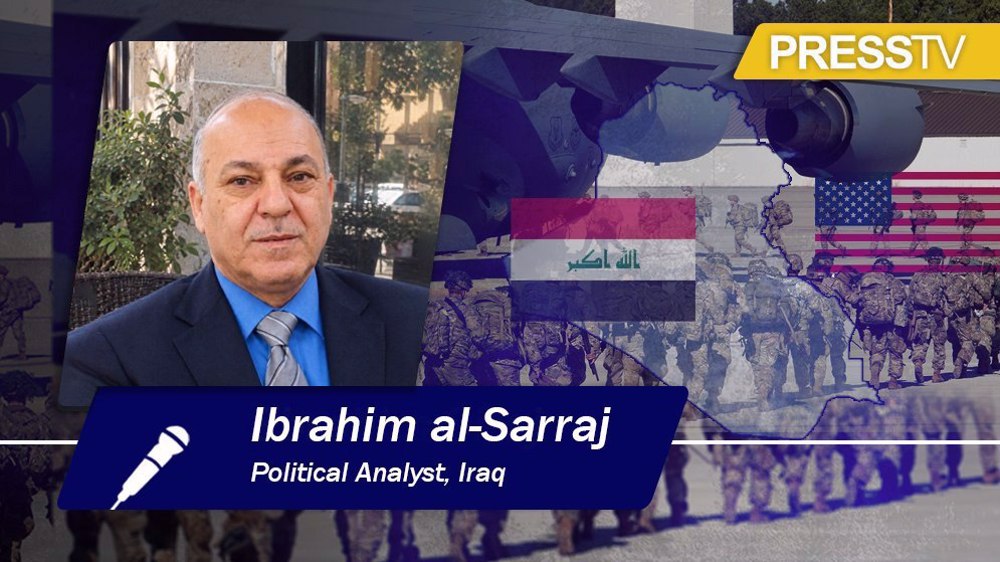
Speaking to the Press TV website, Ibrahim al-Sarraj said that the expulsion of US forces was the result of several pressures converging over time.
“The major victories achieved by the Islamic Republic of Iran in the two recent wars accelerated the withdrawal of the American occupying forces from their bases in Iraq,” he said.
He was referring to the two rounds of unprovoked aggression launched by the US and Israeli regime against Iran in June 2025 and February 2026.
Al-Sarraj, who also heads the Baghdad Association of Writers and Political Analysts, noted that Iraqi resistance groups played a major role in accelerating the withdrawal, while widespread public anger toward the US presence had also grown significantly.
He said many Iraqis regarded the “American occupation as responsible for the region’s crises.”
Iraq’s religious establishment, he added, had likewise been “deeply unhappy with the presence of US forces and Washington’s extensive interference in Iraq’s internal affairs.”
The Iraqi government also insisted that the agreed withdrawal timetable should amount to a genuine military retreat from US bases rather than a nominal change in mission, al-Sarraj said, adding that the demand was ultimately fulfilled.
“All these issues came together and created enormous pressure in this regard, which ultimately led to the Americans’ withdrawal from Iraq,” he said.
The withdrawal on September 30 marked the formal end of the US-led coalition’s military presence in Iraq, more than two decades after the 2003 invasion and following the return of coalition forces in 2014 under the banner of fighting Daesh.
For years, Iraqi political forces and resistance groups had demanded an end to the foreign military presence, particularly after the January 2020 US assassination of General Qassem Soleimani, Iran's top anti-terror commander, and Abu Mahdi al-Muhandis, deputy commander of Iraq's Popular Mobilization Forces.
Al-Sarraj said the developments in recent acts of aggression against Iran had added another decisive factor. He noted that Iran’s military victories, together with sustained attacks by Iraqi resistance groups aligned with Tehran against US bases and interests, accelerated Washington’s decision to leave.
“The Americans realized that they no longer had a place in Iraq,” he said.
Iraqi resistance groups, maintained the analyst, stood fully alongside Iran during the recent US-Israeli war against the Islamic Republic and played a major role in targeting American bases and interests across the region.
He said those groups had also significantly expanded their military capabilities. Rather than relying on older, conventional methods, they had developed capabilities involving ballistic missiles and drones capable of reaching very long distances.
Al-Sarraj said these developments had created a new motivation among resistance forces while simultaneously “disrupting US military calculations.”
Asked whether the expulsion of US forces from Iraq could become the beginning of a broader American departure from West Asia, al-Sarraj pointed to the intensity of Iran’s attacks on US positions across Iraq and the wider region.
He also noted that following Washington’s defeat in its recent attacks against Iran, the United States would inevitably consider reducing its military presence in the West Asia.
More than 17 US bases in the region were targeted by “devastating” Iranian missile attacks, he reminded, adding that countries hosting American military installations were now deeply concerned because the United States had claimed those bases were protected by advanced air-defense systems.
“Ultimately, these bases were destroyed,” he said.
Al-Sarraj said that the damage inflicted by Iran had effectively rendered the military installations of little value.
He further noted that the number of American fatalities might have exceeded 1,000, while saying Washington did not want to disclose the actual figure to the public.
🎥 CBS News photos show extensive damage at US military bases in Saudi Arabia and Kuwait following Iranian retaliatory missile and drone strikes, including a damaged E-3 Sentry aircraft and destroyed vehicles and buildings. pic.twitter.com/KX9hJ7FgpD
— PressTV Extra (@PresstvExtra) September 15, 2026
For Iraq itself, al-Sarraj said the end of the American military presence should now become an opportunity to consolidate national sovereignty rather than simply mark the conclusion of a foreign deployment.
“In my view, September 30, 2026, is the day of Iraq’s independence and the exercise of its sovereignty,” he said.
He urged Iraqi politicians to take advantage of the withdrawal by working toward political, security and economic stability.
Iraq, he said, now needed to focus on unifying its national discourse and freeing its economy from US dominance.
A central issue, in his view, was Iraq’s financial independence. Al-Sarraj said Iraqi funds and financial resources remained stored in the US Federal Reserve and noted that the government had a responsibility to develop a clear strategy for “the liberation of Iraq’s economy from American control.”
He also said Baghdad needed to go further by acquiring advanced air-defense systems.
“Iraq must work to obtain advanced air-defense systems so that its skies are under its own control,” al-Sarraj said.
 This makes it easy to access the Press TV website