
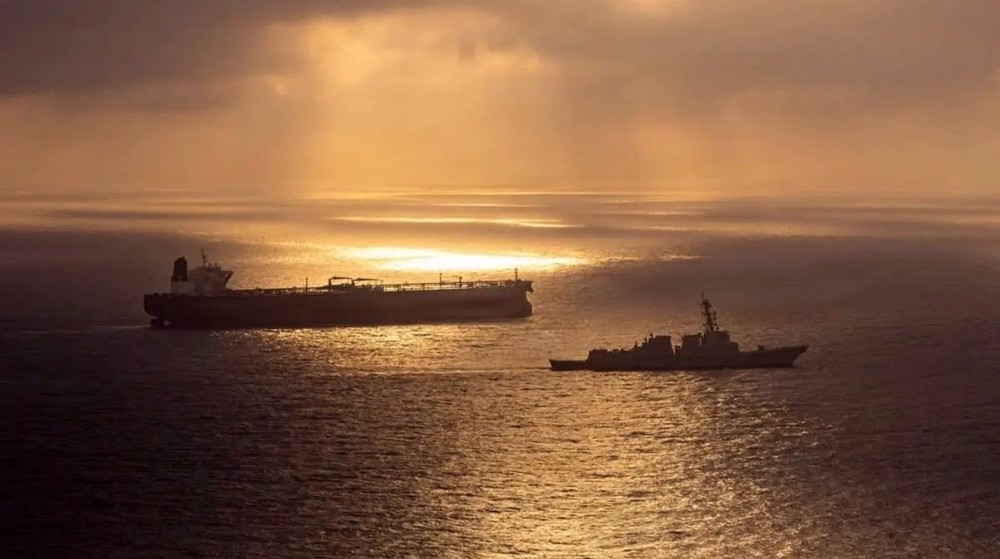
The section of the 14-point memorandum that emphasizes the reopening of the Strait of Hormuz under "Iranian arrangements" has become the focal point of confrontation, driven primarily by hostile US actions and its repeated, explicit breaches of commitments.
The exchange of fire between Iran and the US early Sunday once again demonstrated that Washington is not only unwilling to honor its commitments but has effectively blocked any path toward a diplomatic resolution through hostile actions and repeated violations.
Under the 14-point memorandum signed between Iran and the US, Article Five explicitly assigns the management of the Strait of Hormuz to Iran, giving Tehran responsibility for its future administration and maritime services in consultation with Oman.
The inclusion of the phrase "under Iranian arrangements" in the memorandum reflects recognition of Tehran's central role in governing this strategic waterway.
The text of the memorandum, which was also published by the White House, states that Iran "will guarantee the safe passage of commercial vessels, free of any tolls or charges, for a period of 60 days between the Persian Gulf and the Gulf of Oman".
It says that the Islamic Republic "will consult with the Sultanate of Oman regarding the future administration and maritime services of the Strait of Hormuz."
The wording makes clear that responsibility for administering the strait initially rests with Iran, while Oman assumes a consultative and coordinating role.
Immediately after the memorandum was signed, the United States, in coordination with Oman, unveiled a southern shipping corridor designed as an alternative to the Iranian route through the strait.
In a statement, the Islamic Revolution Guards Corps (IRGC) described the newly announced route as "unacceptable and extremely dangerous," adding that it had been established "without prior notification or coordination with the Islamic Republic of Iran."
As indicated, the actions of the United States and Oman constitute a clear violation of Article Five of the memorandum, which assigned management of the Strait to Iran.
According to unofficial reports, Oman has declined to fully align itself with Iran and continues to insist that maritime traffic should operate in both directions.
This suggests that Oman, under US pressure, has moved away from its neutral position and begun acting in ways that undermine Iranian interests.
Oman's foreign minister told a meeting of the Persian Gulf Cooperation Council that Muscat, as a littoral state, bears a special responsibility and stressed that any future arrangements for the strait should not include transit fees.
This position comes despite Article Five of the memorandum, which designates Iran as the principal authority responsible for administering the strait, while assigning Oman only a coordinating role.
The corridor violation is not the only breach by the US of the memorandum's provisions. The list of America's overt and repeated violations since the signing of the memorandum clearly shows that Washington has never been committed to its obligations:
1. Violation of Article One (Ending the war on all fronts): The United States had committed to ending hostilities across all fronts, including Lebanon, and to securing the withdrawal of Israeli forces from occupied territories.
However, Israeli prime minister Benjamin Netanyahu declared that Israeli troops would remain in Lebanon for as long as necessary. According to this account, Washington neither enforced this provision nor acted to prevent the continued occupation.
2. Violation of Article Two (Respect for sovereignty and non-interference): The United States had pledged to respect the sovereignty of the Islamic Republic of Iran and refrain from interfering in its internal affairs.
However, the military attacks last night on Iranian cities, as well as the attacks of previous nights—all of which originated from or were facilitated by American bases in Saudi Arabia, Qatar, Bahrain, the UAE, and Kuwait—constitute a gross violation of this clause.
3. Violation of Article Four (Lifting the maritime blockade): Washington had committed to ending the maritime blockade and restoring shipping traffic to full capacity within 30 days. Not only was the blockade maintained, but US officials also threatened to intensify it.
President Donald Trump reportedly told Axios that he would not lift the blockade on Iranian ports because doing so would deprive Washington of its principal source of leverage over Tehran.
4. Violation of Article Six (Economic reconstruction): The United States had committed to guaranteeing a comprehensive reconstruction program for Iran backed by at least $300 billion in financing. No meaningful steps were ever taken to fulfill that commitment.
5. Violation of Article Seven (Lifting sanctions): Washington had pledged to terminate all sanctions imposed on Iran. Instead, sanctions remained in place, while the US Treasury warned that if Oman assisted in establishing a toll collection system, it would face "aggressive" sanctions.
6. Violation of Articles Ten and Eleven (Oil export waivers and release of frozen assets): The United States had committed to immediately issuing waivers for Iranian crude oil exports, petrochemical products, and all related services, while also releasing Iran's frozen assets.
Through pretext and hostile actions, the US refused to deliver Iran's $24 billion in blocked assets and revoked Iran's oil sales license, citing Iran's actions against unauthorized vessel movements through the Strait of Hormuz—a justification that stemmed from Washington's own breach of the memorandum.
7. Threats of regime change and assassination of Iranian officials: Despite its explicit commitment not to interfere in Iran's internal affairs, US officials have continued to issue statements advocating regime change.
More importantly, US Secretary of State Marco Rubio openly rejected the prospect of Iranian administration of the Strait of Hormuz, stating: "We will not tolerate that."
Before the US and Israeli terrorist attacks against Iran, the Strait of Hormuz remained open, and Iran had no interest in controlling it. Today, however, Tehran is determined to maintain control over the waterway in the future to ensure that the United States can never again use the Persian Gulf as a staging ground for attacks against Iran.
The strikes carried out last night and on previous nights were launched from or facilitated by US bases in Saudi Arabia, Qatar, Bahrain, the United Arab Emirates, and Kuwait. As long as the United States and Israel pose a threat to Iran's national security, Tehran will maintain a heavy presence in the Strait of Hormuz.
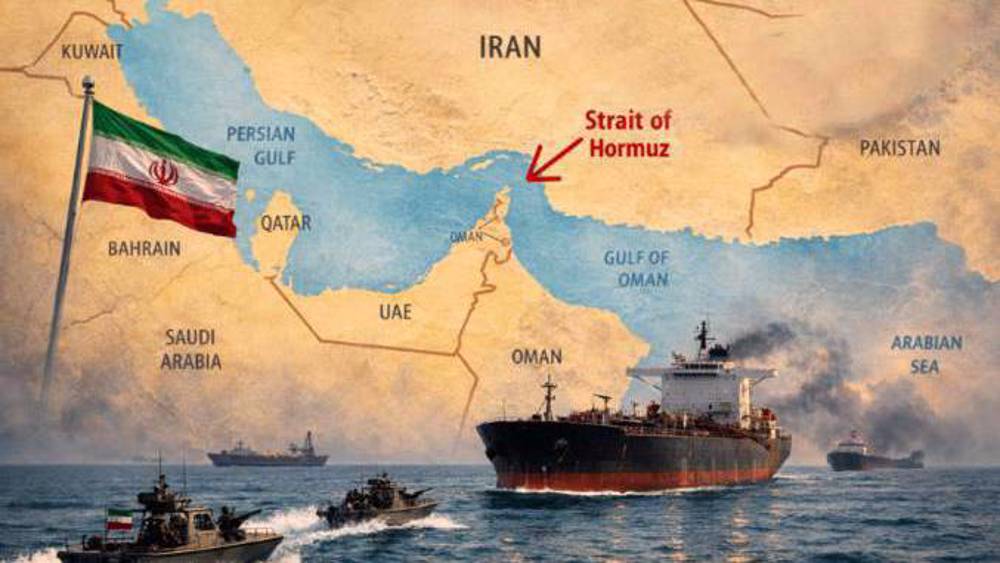
A crucial legal point is that the Strait of Hormuz lies entirely within the territorial waters of Iran and Oman and under international law, no part of it constitutes international waters open to unrestricted passage.
Unlike certain international waterways, the Strait of Hormuz is not part of the high seas but a coastal passage where navigation is governed by the regulations of the littoral states. This legal reality strengthens Iran's position in administering the strait and challenges US claims regarding freedom of navigation.
Iran, based on its defense doctrine, views control of the strait not as an economic instrument but as a vital requirement for its survival and national security.
Parliament Speaker Mohammad Baqer Qalibaf summarized Tehran's position: "The era of one-sided deals is OVER. We told you: keep your word or pay the price. Reality is knocking.”
 This makes it easy to access the Press TV website