
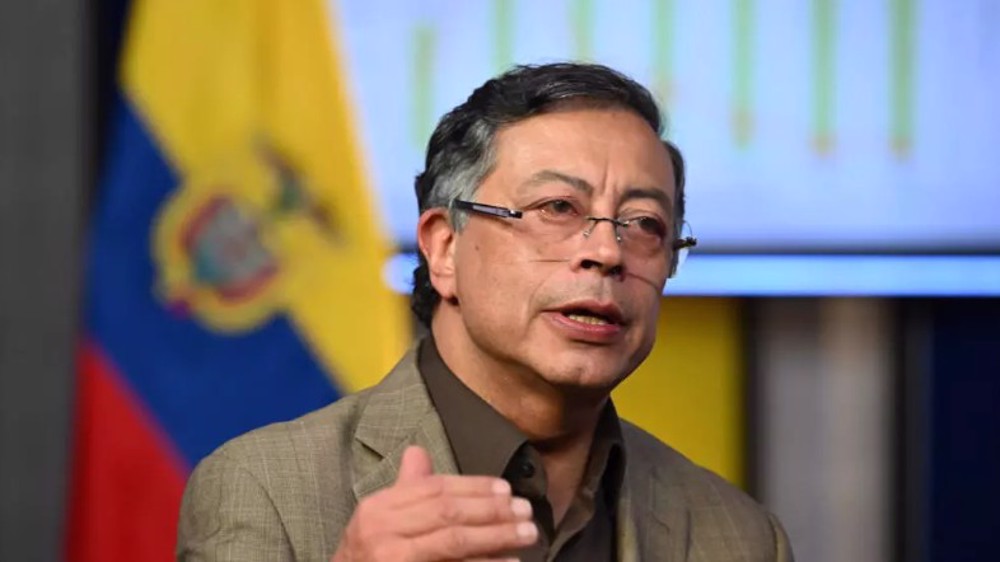
Colombia's outgoing President Gustavo Petro has launched a blistering attack on his US counterpart Donald Trump for backing a hard-right candidate to succeed him, saying Washington is allying itself with the very "narco-traffickers" it claims to combat.
Petro made the remarks in response to Trump's full-throated endorsement of lawyer Abelardo de la Espriella over Senator Iván Cepeda in Colombia's presidential election.
The 47-year-old De la Espriella who unexpectedly topped the first round of voting on Sunday and will face Cepeda in a June 21 runoff made a fortune representing drug-trafficking paramilitaries, fraudsters, and soccer stars.
He is backed by hardline former president Álvaro Uribe, who is accused of colluding with paramilitaries behind the massacres of thousands of civilians during the worst years of Colombia's more-than-six-decade conflict.
"Their [US] allies in Colombia come from the narco-paramilitary regime; they are genocidal and drug traffickers," Petro told AFP in an interview.
Petro expressed "regret" that "figures and governments who want to fight drug trafficking are actually helping to bring crime to political power in Colombia." He noted that Trump reneged on an agreement the pair struck in February not to interfere in Colombia's election.
While Trump accuses Latin American leaders of being soft on drugs, his administration has launched a months-long military campaign in the eastern Pacific Ocean and Caribbean Sea, attacking civilian boats with no evidence provided to substantiate that they were carrying drugs.
Critics have questioned the overall legality of these boat strikes as well as their effectiveness, in part because the fentanyl behind many fatal overdoses is typically trafficked to the US over land from Mexico.
At least 207 people have been killed in these strikes since the administration began its offensive in early September.
The Washington Office on Latin America (WOLA) documented that 32 US military strikes on civilian boats in the Caribbean and Pacific have killed at least 124 people, describing this level of extrajudicial violence as going "beyond the traditional war on drugs".
On January 3, US forces launched a dramatic, night-time raid on Caracas, kidnapping Venezuelan President Nicolás Maduro and his wife Cilia Flores from their compound and bringing them to New York to face "narco-terrorism" charges.
However, internal US government documentation contradicts the administration's narrative.
The Drug Enforcement Administration's (DEA) 80-page 2025 National Drug Threat Assessment mentions Venezuela only six times—fewer times than Canada, a close US ally, which is mentioned seven times.
Mexico is mentioned 70 times. Crucially, the DEA report does not mention the Venezuelan government or President Maduro even once.
The true objectives were laid bare during a White House press conference following the military strikes.
The word "drug" or "drugs" was mentioned only nine times, while the word "oil" was mentioned 27 times. President Trump declared the US would "run" Venezuela and that American oil companies would take over energy production in the seized nation.
The US approach to Colombia fits a broader pattern across Latin America.
According to WOLA, the past year has seen US policy "undermining democracy and human rights promotion, interfering in elections, hitting immigrants from the region quite hard, and taking the 'war on drugs' to new extremes".
In place of cooperation, the administration has embraced coercion. A new doctrine designates Latin America as a top US military priority. Nineteen organizations in the region are now listed as foreign terrorist organizations, up from four in early 2025.
Trump has branded Petro a "sick man who likes making cocaine and selling it to the United States" and said that a similar US intervention in Colombia "sounds good to me".
The threat followed the Venezuela model, where Trump had previously said the operation was just the start of the United States reasserting its two-century-old claim to dominance over its "backyard".
In response to these threats, Petro has warned that Latin American countries must unite or risk being "treated as servants and slaves" by the United States.
He has called for regional solidarity against what he describes as an ideological policy that "divides the world between those who think like them and those of us who don't."
 This makes it easy to access the Press TV website