

The halt of activity at Jebel Ali port in the United Arab Emirates due to heightened tensions in the Persian Gulf has forced Iran to accelerate a long-planned diversification of its trade routes.
The US and Israeli terrorist war on Iran and its effect on the country's foreign trade chain have led to the creation and development of new routes, with Pakistani, Indian and Omani ports rapidly replacing the Emirati hub as entry points for Iranian trade.
In fact, what was intended to weaken and restrict the Islamic Republic has instead turned into a transformation in the country's logistical position.
Jebel Ali, West Asia’s largest container terminal, has seen operations effectively paralyzed since late February, when Iran imposed selective passage through the Strait of Hormuz following the outbreak of the terrorist war.
Major shipping operators including Maersk, Hapag-Lloyd, CMA-CGM and MSC have all halted Hormuz transit, according to industry tracking data.
Iran has moved from dependence on a single offshore hub to activating multiple land and maritime corridors simultaneously, as trust in Jebel Ali as a neutral platform is gone.
Simultaneously with the intensification of wartime conditions and the halt of activities at Jebel Ali, the ports of Pakistan, India and Oman have quickly replaced it in Iran's commodity and logistics exchanges.
Eight alternative corridors and routes have been identified, and executive planning for their development has been carried out, according to Mohammad Sadegh Ghannadzadeh, deputy of Iran's Trade Development Organization.
Negotiations and agreements for the full activation of routes and adjustment of transport tariffs are reportedly underway.
A significant portion of these alternative routes are overland and rail, neutralizing US President Donald Trump’s delusional naval siege of Iranian ports and piracy against the country’s commercial vessels.
On Friday, he did not mince his words when he told a rally in Florida that the US navy acted “like pirates” as he described an operation stealing an Iranian oil tanker in the Sea of Oman.
The Iranian government, in cooperation with the private sector, has designed and implemented a set of alternative solutions to sustain the trade flow, focusing particularly on developing northern and western routes away from the traditional southern maritime axis.
Iran's foreign minister, Abbas Araghchi, pushed the diplomatic architecture with an April 23 tour that included two trips to Pakistan, stops in Oman, and a 90-minute meeting with President Vladimir Putin in St Petersburg.
Despite intensified tensions and piracy by the Zionist and American enemy, unloading and loading operations, vessel traffic and berthing at Iran's southern ports continue normally, with no interruption in the flow of goods.
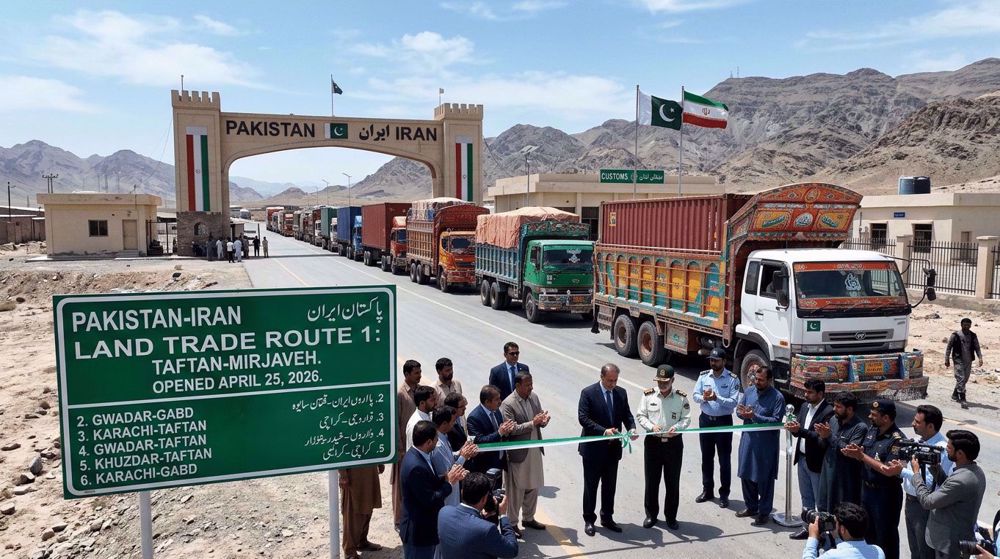
The most significant breakthrough has come from Islamabad. Pakistan has designated six transit routes, forming a wide network for overland trade into Iran in a bid to bypass the maritime trade routes in the Persian Gulf.
The corridor not only helps increase the speed of cargo movement and reduce costs, but also, by connecting to the $60 billion China-Pakistan Economic Corridor and the Belt and Road Initiative, forms a strategic bridge between South Asia and Eurasia.
The crisis has also breathed new life into the International North-South Transport Corridor (INSTC) and given the plan new urgency.
Chabahar port, Iran’s only oceanic port which experts believe will be the site of a future great power war, has not been properly utilized.
For years, its development and that of its hinterland rail link to Sarakhs have remained incomplete for trade development with Central Asia. The new developments have created fresh momentum towards its serious completion.
Foremost, however, the developments serve as practical confirmation that Iran's geography is a trump card against any economic siege.
The transport industry is considered the backbone of the economy and trade, and is directly and indirectly connected to other commercial sectors including banking, insurance and trade finance. Dependence on Jebel Ali port carries risks for Iran's economy.
For example, any disruption at the port could negatively affect Iran's foreign trade, with Iranian containers pushed down the queue during busy commercial seasons and forced to wait extended periods for transfer to Iranian ports.
On the political front, tension between Iran and the UAE, fueled by Abu Dhabi's accelerating embrace of Israel, risks shrinking Iranian trade and exports – a dynamic that played out plainly in Monday's events.
Authorities in Fujairah said on Monday that a fire broke out at the Fujairah Oil Industry Zone, accusing the Islamic Republic of Iran of launching a drone strike.
Citing a senior military source, IRIB said the Iranian armed forces had no premeditated plan to attack the aforementioned oil facilities.
The blaze, it said, at oil facilities in Fujairah Port on Monday was a direct consequence of American adventurism in the strategic Strait of Hormuz.
What traditionally gave Jebel Ali preference through its corridor and artery connections with surrounding countries has inevitably changed due to the fundamental geopolitical shifts in the region and the path that the UAE has taken with Israel.
 This makes it easy to access the Press TV website