
By Press TV Website Staff
The high-stakes negotiations in Islamabad collapsed because Washington attempted to extract at the diplomatic table the concessions it fundamentally failed to secure during its 40-day war against Iran, says an analyst.
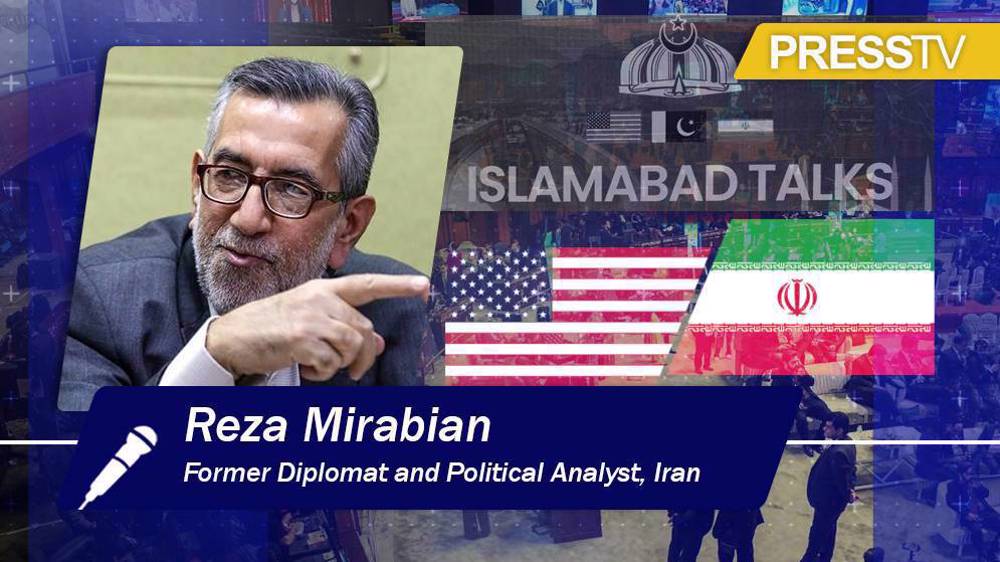
In an interview with the Press TV website, former Iranian ambassador to Kuwait Reza Mirabian noted that during the Saturday talks in the Pakistani capital, the Americans acted contrary to what they initially accepted, referring to a pre-agreed 10-point Iranian proposal.
This shift, he asserted, was "because they felt that perhaps they could achieve during the negotiations what they had failed to obtain in the war."
The talks followed a devastating US-Israeli military campaign that began on February 28, targeting civilian areas, schools, and hospitals, and assassinating top officials, including the Leader of the Islamic Revolution, Ayatollah Seyyed Ali Khamenei.
In response, Iranian armed forces carried out 100 waves of retaliatory Iranian strikes under Operation True Promise 4, pounding Israeli and American military assets in the region.
Having hit a strategic dead end after facing fierce Iranian resistance, Washington was compelled to seek a diplomatic off-ramp.
"We did not request negotiations; the Americans did," Mirabian told the Press TV website. "They imposed the war on us, and we resisted. They reached a dead end and requested negotiations, asking other countries to facilitate."
The trajectory of shifting regional equations left the US with few alternatives. Had Iran continued its retaliatory attacks on US interests, especially those related to energy, the resulting global energy crisis would have crippled Washington and its close allies.
Furthermore, the war imposed unprecedented costs on the US war machinery, exposing deepening divisions with Europe, intensifying distrust among Arab allies, and inflicting a severe reputational defeat on the global stage.
Iran entered the Pakistani-mediated talks from a position of undeniable strength.
April 12: Fragile ceasefire in effect as Iran-US talks in Islamabad end without breakthroughhttps://t.co/GaF416Ciny
— Press TV 🔻 (@PressTV) April 13, 2026
"The Americans' miscalculation was imagining that after 40 days of war, fatigue, and the damage Iran imposed on them, they could extract concessions from Iran at the negotiating table," the former diplomat noted.
This miscalculation derailed what Iranian Foreign Minister Abbas Araghchi noted was just inches away from becoming the official "Islamabad MoU."
Following 21 hours of intense dialogue with a US delegation led by Vice President JD Vance, Araghchi lamented that Washington offered only maximalism and shifting goalposts, proving that “zero lessons” were learned from past failures.
According to Mirabian, the US derailed the agenda by introducing two entirely unapproved topics: the domestic enrichment of nuclear materials and the control of the Strait of Hormuz.
The US proposed a joint American-Iranian administration over the strategic waterway, the former ambassador noted. This demand came shortly after a major diplomatic defeat for the US at the United Nations Security Council, where an anti-Iranian resolution pushed by Bahrain to force open the Strait was effectively vetoed by Russia and China.
"The United States has no connection to the management of the Strait of Hormuz," Mirabian said. "If there is to be joint management, it would be between Iran and Oman. US proposal was strongly rejected by the Islamic Republic. Management of the Strait of Hormuz is with Iran."
Regarding the nuclear issue, the analyst emphasized that Iran had already made its red lines clear. Tehran maintains that uranium enrichment must occur domestically, and its stockpiles will never be transferred abroad.
Because Iran recognized that the US came solely to secure wartime prizes, it adamantly refused to yield. "Naturally, it seems they had no success in this regard and left the negotiations empty-handed," Mirabian remarked.
The Iranian delegation arrived in Islamabad on Friday, viewing diplomacy as the continuation of a war. Their goal was to harvest the fruits of resistance: consolidating authority over the Strait, securing war reparations, unfreezing assets, and lifting illegal sanctions.
✍️ Viewpoint - End of American exceptionalism: How MAGA foreign policy collided with reality in war on Iran
— Press TV 🔻 (@PressTV) April 13, 2026
By Y. P. Rāzihttps://t.co/HDJ291jlIS pic.twitter.com/q2MgLy4jGI
This assertive posture was bolstered by massive domestic solidarity. The enemy failed to engineer an internal coup or create a rift between the Iranian people and the government, witnessing daily nationwide demonstrations in support of the establishment.
Reflecting this confidence, Parliament Speaker Mohammad Baqer Qalibaf, who led the Iranian delegation, delivered a warning upon returning to Tehran. Reminding Washington of a 77-year wall of mistrust, he stated that the Iranian nation does not bend to threats.
“If you go to war, we will fight you, and if you come forward rationally, we will respond rationally," Qalibaf declared, addressing the US leadership directly. "We will not bow to any threat. Test our resolve once again, so that we will teach you a greater lesson.”
Beyond American maximalism, Mirabian pointed to another critical factor behind the diplomatic breakdown: the destructive role of the Israeli regime.
While the pre-agreed 10-point framework stipulated a comprehensive ceasefire, Israel aggressively violated this by continuously bombing southern Lebanon up until the final moments of the talks.
"Israel's role was, at the very least, insisting that the ceasefire not include Lebanon and the issue of Hezbollah," Mirabian said. "They refused to accept this until the last minute and constantly bombed southern Lebanon, and a ceasefire was not realized."
For Tehran, securing a lasting halt to the regime's attacks on Lebanon held immense strategic value—arguably greater than launching further retaliatory missile strikes, which is why Iran held its fire during the diplomatic window.
The analyst noted that Tel Aviv actively engineered the collapse of the diplomatic process.
"Just as the Israeli lobby in the US unfortunately instigated the Americans in the past, it seems the Zionist lobby's influence within the US was not ineffective in these recent negotiations," he told the Press TV website.
 This makes it easy to access the Press TV website