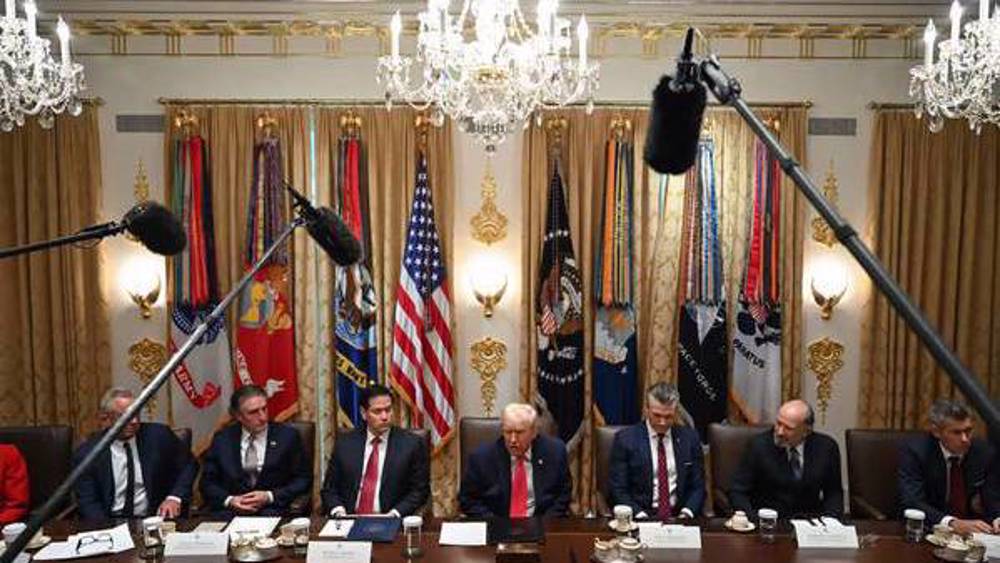
A deepening internal tug-of-war is reportedly paralyzing the White House, as US President Donald Trump's advisors clash over how to define "victory" amid a global energy crisis and significant strategic miscalculations regarding the unassailable resilience of the Iranian nation.
Citing a Trump adviser and sources close to the matter, Reuters reported a stark division within the administration over how to end the war with the Islamic Republic, which is now dragging into its third week.
On one side, the report said, hawks like Senators Lindsey Graham and Tom Cotton are pushing for a sustained offensive against Iran.
They argue that the US must prevent Iran from obtaining a nuclear weapon and respond forcefully to attacks on American troops and shipping in the Persian Gulf. Iran has always said it does not want to acquire nuclear weapons.
On the other side, political advisors—including Chief of Staff Susie Wiles and media figures like Tucker Carlson—are urging an immediate de-escalation. They argue that a prolonged war in West Asia directly violates Trump’s core campaign promise to end "stupid" foreign interventions.
Meanwhile, the recent surge in gasoline prices—triggered by US-Israeli aggression against Iran—has concerned Trump’s economic advisors, including those from the Treasury Department and the National Economic Council.
According to the report, they have issued dire warnings to the president, arguing that an economic shock will erode Trump’s base of support faster than any military setback.
Political advisors, including Chief of Staff Susie Wiles and Deputy Chief James Blair, are making similar arguments, focusing on the political fallout from higher gas prices and urging Trump to define “victory” narrowly and signal that the operation is limited and “nearly finished,” the sources said.
Trump’s rhetoric has fluctuated wildly in a single day. He claimed "we won" the war with Iran, only to pivot moments later and say "we must finish the job."
Launching an unprovoked war on Iran—along with the Israeli regime—on February 28, the US president failed to offer even a shred of credible explanation to the American people.
Instead, his administration has offered justifications ranging from thwarting what they claimed was an imminent attack by Iran to crippling its nuclear program to regime change.
Ever since, Iranian armed forces have carried out retaliatory attacks on US military assets in regional countries and the Israeli-occupied territories.
On the other hand, Iran’s absolute command over the Strait of Hormuz—the world’s energy artery—has also left the Trump administration reeling, as soaring gas prices have ignited a political firestorm that threatens to topple Republican majorities in Congress and end Washington's interventionist campaign, according to the report.
Facing the unshakable stability of the Iranian leadership, Trump has been forced to retreat from his delusions of regime change.
Intelligence reports now show that Tehran is nowhere near collapse, shattering the White House’s naïve attempts to replicate the Venezuela raid.
The US administration’s fatal error was treating a sovereign power like Iran with the same simplistic playbook used in the January 3 kidnapping of Venezuela's president, Nicolas Maduro.
Furthermore, experts have shattered the fabricated narrative pushed by Trump’s inner circle, rejecting claims that Iran was seeking to produce nuclear weapons.
Tehran has always insisted that its nuclear program is strictly for peaceful goals, such as generating electricity and conducting medical research.
For the Islamic Republic, its peaceful nuclear program is a matter of national pride and a legal right that it refuses to give up, despite years of international pressure.
 This makes it easy to access the Press TV website