French rail workers strike to protest planned labor reforms
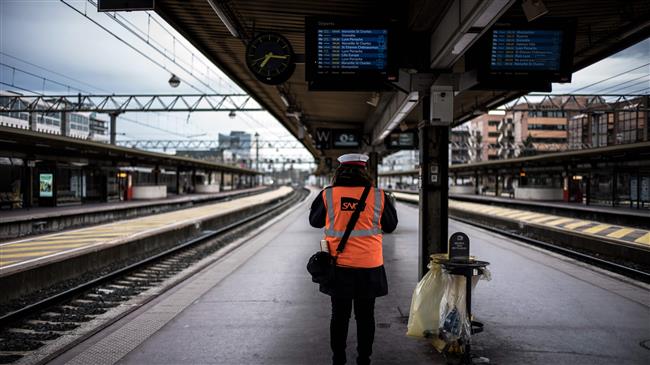
Rail workers in France have staged a three-month rolling strike as part of a series of walkouts to protest President Emmanuel Macron’s sweeping labor reforms agenda.
The strike officially began Monday and is expected to cause major problems for France’s estimated 4.5 million train passengers, with stoppages planned for two out of five days until June 28 unless Macron backs off from his bid to force a major overhaul at state-owned railway SNCF.
Local media have predicted a “black Tuesday” for the country’s rail passengers as only one high-speed TGV train out of eight and one out of five regional trains is scheduled to operate, causing major difficulties for businesses across France as staff struggle to get to work.

Staff at Air France, garbage collectors, and some energy workers will also begin separate strikes on Tuesday in what the local media have described as the largest wave of industrial action since Macron rose to power last May.
Managers at Air France said that 75 percent of their flights would operate despite the fifth strike over pay in more than a month, though further walkouts are planned for April 7, 10, and 11.

French unions accuse Macron — a centrist former investment banker — of seeking to “destroy the public railways through pure ideological dogmatism.”
They further fear that Macron’s plans to turn the SNCF into a publicly-listed company — despite the government owning 100 percent of the shares — may eventually lead to the rail operator being privatized.
The industrial move also serves as a test of how much influence France’s once fearsome unions can still wield.
The government has criticized the strikes.
“We need to rid this country of its strike culture,” said the spokesman for Macron’s Republic on the Move (LREM) Party, Gabriel Attal, as quoted by France’s Inter Radio on Monday.
Macron, meanwhile, insists that the SNCF — saddled with 46.6 billion euros of debt — needs to make major adjustments as EU countries prepare to open passenger rail to competition by 2020.
Moreover, the government says that running a train in France is 30 percent more expensive than elsewhere in Europe, and intends to strip new SNCF hires of special rail workers’ statuses, which guarantee jobs for life and early retirement.

However, unions object to the move, fearing that such changes are a first step toward privatizing the SNCF — a claim rejected by the government.
As with his reforms loosening France’s rigid labor code, Macron plans to push through the SNCF overhaul by executive order to avoid a potentially drawn-out parliamentary debate, a move his critics have slammed as undemocratic.
French pensioners, students, and public sector workers have already waged street rallies in recent weeks protesting against Macron’s widespread reform plans.
Macron warns Beijing of tariffs in bid for EU-China trade deal

EU targeting platforms that refuse to ‘censor free speech’: Telegram CEO

Niger accuses French nuclear giant Orano of ‘mass crimes’



WHO: Over 1,000 Palestinians died awaiting medical evacuation from Gaza
US university fires Iranian professor over support for Iran, Palestine
VIDEO | Anti-Trump activists deliver ‘people’s indictment’ at White House
EU’s tampering with Russian assets is ‘theft’ no matter how it’s framed: Moscow
Israeli army kills Palestinian teen during northern West Bank raid
VIDEO | Two killed, nine wounded in mass shooting at Brown University
VIDEO | Germany considers Tunisia for migrant 'return center' plans
VIDEO | UK protesters show solidarity with Palestinians at Christmas




 PressTV NEWSLETTER
now
PressTV NEWSLETTER
now

 This makes it easy to access the Press TV website
