People, faith, history, sovereignty: Unpacking Leader's latest speech and warning to Trump
By Nahid Poureisa
Amid a torrent of global headlines amplifying the American naval presence in waters near Iran, and non-stop narratives touting Washington’s supposed ability to devastate the country, a parallel campaign of full spectrum cognitive warfare has unfolded against the Islamic Republic of Iran.
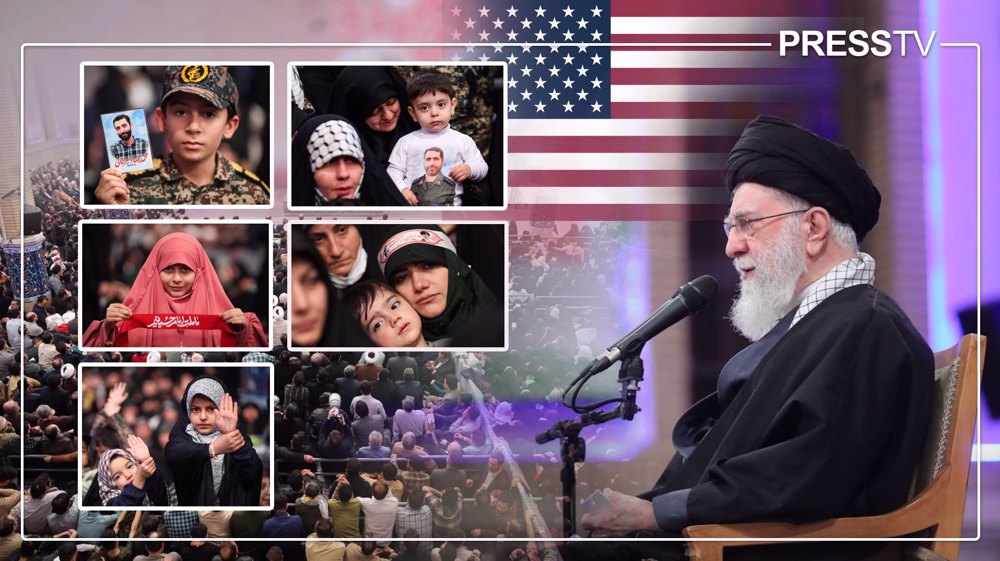
In this charged atmosphere, Leader of the Islamic Revolution, Ayatollah Seyyed Ali Khamenei, delivered an important speech on Tuesday that resonated with calculated deterrence and commitment to safeguarding the country's sovereignty.
His powerful and carefully measured words cut through the din of psychological warfare and military theatrics, demonstrating resolve while reinforcing Iran’s strategic stance in the face of mounting external pressure.
His response to US President Donald Trump’s war rhetoric was a clear reflection of extraordinary strength and resolve widely applauded by people across the world.
Analysts have noted a consistent pattern in the behavior of the current US president. Though he cultivates an image of unpredictability and volatility, his actions reveal a predictable reality: when confronted with firm resistance from a powerful nation, his bellicose rhetoric gives way to retreat.
What Ayatollah Khamenei conveyed through his latest speech reflects Iran’s demonstrable strength - both militarily and socially. That generates momentum, forcing the US to pause, reassess, and reconsider its moves.
Unlike Trump, whose strategy relies heavily on bluffing to intimidate and then withdrawing when challenged, Leader of the Islamic Revolution speaks from a foundation of real power: a nation that has repeatedly demonstrated its ability to push back against adversaries and protect its sovereignty.
🔴 "He says, 'We have the world's strongest army'; the strongest army in the world may sometimes receive a blow so severe that it cannot get back on its feet."
— Press TV 🔻 (@PressTV) February 17, 2026
🔴 "A warship is dangerous, but more dangerous is the weapon that can send it to the bottom of the sea."
- Leader pic.twitter.com/0g9iSsVjNF
On February 18, thousands from Iran’s East Azerbaijan province attended the meeting where Ayatollah Khamenei delivered his speech. The event commemorated an uprising 48 years ago in Tabriz, when the streets similarly teemed with people.
In 1978, anger ignited across the northern Iranian city, setting in motion the events that would eventually topple the old monarchist order. This year’s meeting did not just recall history, it stood within it. Power had shifted once before; now it bore witness again.
The people of Tabriz had gathered to mourn those killed in protests in Qom. Likewise, Ayatollah Khamenei’s speech unfolded within a similar symbolic frame: a fortieth-day commemoration for those killed during the recent foreign-backed terrorist attacks.
The meeting linked past and present, placing today’s events within the same historical arc that forged the revolution.
Ayatollah Khamenei began by emphasizing that this year stands out in unprecedented ways.
“This year’s meeting is an exceptional meeting. This year was an extraordinary year. The Iranian nation, at multiple stages, demonstrated its greatness, its will, its firm determination, and its capabilities; from the twelve-day war to the recent events,” he said.
He framed it as a year in which the strength of the Iranian nation revealed itself. He noted that the number of people from Tabriz who participated in the 47th anniversary rally of the Islamic Revolution had doubled. This reflected a central point of his speech: the people as the axis of the Islamic Republic.
Leader: US won't be able to destroy Islamic Republic@iammoeen14 reports from Tehran.
— Press TV 🔻 (@PressTV) February 18, 2026
Follow: https://t.co/mLGcUTSA3Q pic.twitter.com/VFX4n63Cao
The failed to coup
Leader of the Islamic Revolution did not describe the recent foreign-backed riots as spontaneous protests. He described them as something far more serious: a coup attempt, repeating what he said in his previous speech as well.
He explicitly rejected the narrative that the events were simply expressions of anger or random outbursts. Instead, he stated clearly:
“What happened was a coup attempt that failed. It was not merely that some young people became angry and protested. No. It was more than that. It was a coup. But this coup was crushed under the feet of the Iranian nation.”
According to Ayatollah Khamenei, foreign intelligence agencies, including the CIA and Mossad, had spent years identifying individuals inside Iran, recruiting them, training them, and providing them with money and weapons.
These individuals were prepared for sabotage and tasked with infiltrating military centers, government facilities, and sensitive infrastructure. They were waiting for the right moment to act.
Their strategy, he explained, was modeled on extreme violence. He compared their methods to those used by terrorist groups such as Daesh. Their objective was to foment chaos through killings, vandalism, and spreading terror in society.
Thousands of innocent Iranians lost their lives as a result of those actions. But eventually the coup attempt failed.
"In the end, whether the enemy accepts it or not, this coup, prepared with so much effort, expenses, and planning, collapsed and was defeated," Leader of the Islamic Revolution said.
He made it clear that what had occurred was not a minor incident but a major plot and the outcome was decisive: the defeat of the enemy and the victory of the Iranian nation.
He also pointed to the participation of millions of Iranians in countrywide demonstrations, particularly on February 11, as irrefutable evidence of the national commitment to their political system.
🔴 Leader: More dangerous than the American warship is the weapon that can send it to the bottom of the sea.
— Press TV 🔻 (@PressTV) February 17, 2026
Follow: https://t.co/mLGcUTS2ei pic.twitter.com/Z5QpFxAzp1
Definition of the nation: Who is a martyr
One of the most striking and significant aspects of Leader speech was his careful and generous categorization of those who had lost their lives during the recent riots.
The first group consisted of defenders of national security: members of the Basij, the Islamic Revolution Guards Corps, and other security forces. These martyrs risked their lives to protect their country, and Ayatollah Khamenei described them as among the highest-ranking martyrs.
The second group included ordinary civilians, passersby who were not involved in any confrontations but were killed as a result of the rioting and terrorist attacks. They, too, were honored as martyrs.
The third group carried the deepest political significance. These were individuals who had been misled, who had participated in the riots out of deception or inexperience. Ayatollah Khamenei said, despite their mistakes, they remained part of the nation.
“They are ours. They are our children,” he said.
Even those who had opposed the system were not considered outside the nation. Their deaths were recognized as part of the national tragedy.
This definition reflects the political doctrine articulated by the Leader: the Islamic Republic is inseparable from its people, including them all, even those who had been misled. Only those who directly organized, armed, and funded on the orders of foreign intelligence agencies were excluded from this national framework.
Leader’s remarks disrupted enemy’s warlike equations: Iranian lawmakershttps://t.co/pumeLrgG6K
— Press TV 🔻 (@PressTV) February 18, 2026
School of Imam Hossein, and Iranian identity
One of the most powerful parts of Leader's speech was his reference to the moral and historical foundations of Iranian resistance.
Invoking the legacy of Imam Hossein (as), he cited the famous saying of the master of martyrs: “The likes of me do not pledge allegiance to the likes of Yazid.”
He used this phrase to draw a direct historical parallel between the Iranian nation and Imam Hossein’s refusal to submit to illegitimate authority embodied by Yazid.
This was not merely a religious statement, it was a declaration of identity, culture, history, and geopolitics. Ayatollah Khamenei emphasized that the Iranian nation, with its long history and deep-rooted culture, will never bow to a corrupt system like that of the United States, which he described as morally and historically compromised.
This historical and moral framing underpinned the entire speech, linking Iran’s modern resilience directly to the enduring values of the school of Imam Hossein (as).
Importantly, when Ayatollah Khamenei spoke of Iran’s real power and authority, he did not point to regional influence, to the allies of the Axis of Resistance from Lebanon to Yemen, or to advanced military technology. He did not say that Iran’s strength comes from millions of followers across the globe willing to sacrifice their lives.
Rather, he stated clearly that Iran’s true strength lies in the Islamic Republic’s deep roots among its own people.
This point is critical: the American empire suffers in large part due to its complete disconnect from its own population, particularly in the wake of scandals such as the Epstein files. This is just one example among many, with more yet to come to light.
Warships can be sent to the seabed, Leader says in response to Trump’s threatshttps://t.co/Lg9ej9h6lv
— Press TV 🔻 (@PressTV) February 17, 2026
The decaying and dying Epstein Empire
Ayatollah Khamenei then turned his attention to the United States, describing it as an empire in decline. He pointed to economic crises, political division, and social instability within the country itself, summarizing the core conflict in stark terms: the United States seeks to dominate Iran, and the Iranian nation stands firmly in its way.
Ayatollah Khamenei referenced admissions by an American president acknowledging that the US had failed to eliminate the Islamic Republic. He emphasized that this failure was not due to a lack of effort but to the resilience of the Iranian nation. He further stated that the current US President would similarly fail to defeat Iran.
Image of sovereignty and deterrence
When addressing military threats, Ayatollah Khamenei spoke of the US naval presence in the Persian Gulf region, stressing that military hardware alone does not determine outcomes.
Warships, he noted, are not invulnerable as many pundits assume, they can be destroyed by equally or more powerful weapons. His words were measured, representing a firm yet peaceful discourse: Iran’s foreign policy is grounded in sovereignty and national security, demonstrating the consequences of any miscalculation by adversaries and reducing the likelihood of war.
He said that even the world’s strongest military could suffer blows from which it could not recover. When he mentioned weapons capable of sinking warships to the seabed, the crowd responded with loud chants and applause, continuing until he himself signaled for calm.
Their reaction reflected resolve, not fear: Years of pressure and threats had not shaken their confidence or steadfastness.
Leader of the Islamic Revolution says the US will fail to defeat Iran, warning of a possible strong response as Donald Trump boasts about the US military.
— Press TV 🔻 (@PressTV) February 17, 2026
Follow: https://t.co/GKZwI4ePgj pic.twitter.com/pSHniK03Zf
The tree that could not be uprooted
Ayatollah Khamenei used a powerful metaphor to describe the Islamic Republic. He said that in its early days, the Islamic Republic was like a fragile sapling, yet even then, its enemies could not uproot it. Today, it has grown into a strong and fruitful tree.
“The Islamic Republic is not separate from the people. The Islamic Republic is from the Iranian nation.” He emphasized that the strength of the Islamic Republic lies not in weapons alone, but in its roots, in its people.
From his speech, it becomes clear that the force capable of confronting enemy warships is not merely military capability, but the deep resilience of a nation shaped from within: a nation rooted in the school of Imam Hossein (as), guided by political Islam, and able to integrate faith into governance.
This nation understands that there is no place for allegiance to Yazid, and that the global embodiment of Yazid today is Trump.
Negotiation and sovereignty
Ayatollah Khamenei also addressed the ongoing indirect nuclear negotiations with the US. He emphasized that true negotiation cannot occur when one side dictates outcomes in advance. It requires equality and mutual recognition of sovereignty.
The Islamic Republic, he stressed, does not negotiate from the point of weakness. For 17 years, it has faced pressure, threats, sanctions, and attempts at overthrow, and it has still endured.
Beginning and ending with the people
Ayatollah Khamenei concluded the speech by addressing Iranian officials, emphasizing the importance of improving economic conditions, reducing inflation, strengthening the national currency, and enhancing the lives of the ordinary Iranian people.
He began his speech with the people and he ended his speech with the people. This continuity reflects the central message of his address: the Islamic Republic is strong because it is rooted in its nation.
The uprising in Tabriz demonstrated how a political system collapses when it loses connection with its people. The endurance of the Islamic Republic demonstrates the opposite. It is not sustained by external approval, it is sustained by its roots. And those roots remain intact.
Press TV’s website can also be accessed at the following alternate addresses:
Why Trump's anti-Iran naval coalition in Strait of Hormuz is doomed to fail
US-orchestrated asylum plot or homeland? Iranian women footballers make their choice
Trump’s military gamble against Iran backfires spectacularly with no exit strategy


 This makes it easy to access the Press TV website