

Last week, Leader of the Islamic Revolution Ayatollah Seyyed Mojtaba Khamenei urged officials to expand the national dryland-farming initiative, especially its production of wheat and other strategic crops.
The directive prompted Agriculture Minister Gholamreza Nouri Ghezeljeh to meet Energy Minister Abbas Aliabadi and Seyyed Parviz Fattah, head of the Executive Headquarters of Imam Khomeini’s Order, which has supported the scheme since 2020.
Fattah said after the meeting that the program had achieved a production breakthrough and self-sufficiency milestone in 2024, and recalled that a joint report presented to martyred Leader Ayatollah Seyyed Ali Khamenei received his approval.
The late Leader’s handwritten response was direct, stating the plan had worked well and should continue, as he thanked those responsible for carrying it forward as a continuing national effort across Iran.
This continuity matters because dryland farming is part of a long-running effort to adapt Iranian agriculture to its climate and strategic circumstances.
For years, critics of domestic food production have argued that importing crops can be cheaper than growing them at home, particularly when foreign suppliers enjoy higher yields or lower production costs.
That calculation, however, overlooks the cost of vulnerability when wars, sanctions, shipping disruption or political pressure threatens access to essential supplies, even when overseas prices initially appear attractive to importers.
In June 2020, the martyred Leader addressed this argument explicitly, saying cheaper imported wheat did not settle the question because suppliers might refuse sales for political reasons during a crisis.
He urged self-sufficiency in strategic products, including wheat, oilseeds, medicinal plants and livestock feed, while emphasizing modern irrigation, watershed management and protection of underground water resources for future generations of farmers.
Recent terrorist wars and attacks on Iranian infrastructure have made the broader lesson tangible: food security is not merely about prices, but whether a country can reliably feed its people under pressure.
That does not mean every crop should be produced domestically regardless of cost or ecology; it means strategic choices must account for supply risks, water realities, farm incomes and the value of resilient local capacity.
According to FAOSTAT data compiled by Our World in Data, Iran’s wheat harvest rose from about 2.9 million tonnes in 1961 to 16.75 million tonnes in 2024, a transformation across generations.
The Food and Agriculture Organization estimated Iran’s 2025 wheat harvest at 12 million tonnes, roughly 16 percent below its five-year average, after prolonged dry weather damaged crops across major growing areas.
By June 2026, the FAO forecast a near-average cereal harvest, helped by precipitation from mid-December through February that replenished soil moisture during key crop-development stages across major producing provinces nationwide.
Iranian officials later announced a record wheat harvest of 14.1 million tonnes in 2026, alongside a reported seven-million-tonne increase in total agricultural and horticultural output compared with the previous year.
The dryland production jumpstart scheme began in autumn 2020 with 670,000 hectares across six provinces, then expanded through additional provinces, villages, farmers and agricultural specialists as the program developed.
The Agriculture Ministry has also said domestic production now covers around 85 percent of Iran’s food requirements, a significant capacity that still leaves important imports, including feed grains, exposed to international markets.
Program reports describe coverage reaching 5.2 million hectares, more than 22,000 villages and approximately 510,000 farmers, with over 5,000 experts and extension workers helping move knowledge into fields.
Dryland farming offers a different resource equation. Rather than relying on irrigation drawn from rivers, reservoirs or aquifers, crops use rainfall stored in soil, often called green water by researchers.
In the 2022–2023 agricultural year, program figures cited wheat yields of about 1,442 kilograms per hectare on participating dryland farms, compared with roughly one tonne per hectare outside the scheme.
Dryland agriculture is not risk-free, and yields can fall sharply when rainfall arrives late, stops during critical growth stages or fails altogether in a drought year.
The best dryland strategy combines locally adapted seeds with soil conservation, moisture retention, suitable planting equipment, crop diversification and timely access to forecasts and agronomic advice tailored to local conditions.
In a 2006 address to farmers, the martyred Leader called wheat self-sufficiency a major national achievement and urged the country to bring science, technology, ambition and hard work to agriculture.
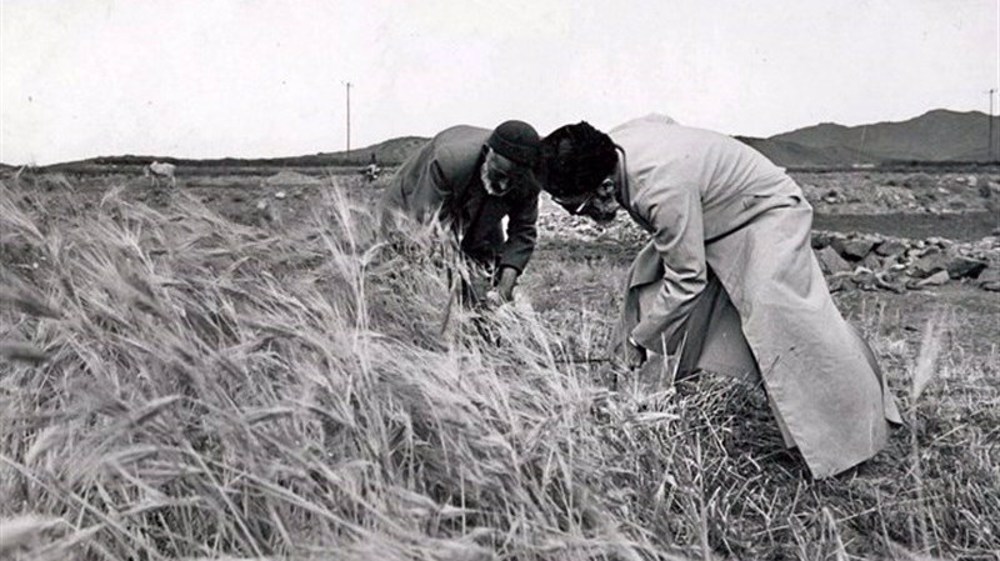
Rain-fed farming therefore offers Iran a way to pursue production while treating water as an ecological limit, not simply an input expanded whenever harvest targets rise or markets demand more.
The Agriculture Ministry says it is preparing improved seeds and inputs for the current season and coordinating with energy and meteorological authorities to strengthen wheat production and improve the scheme’s results.
Officials have pointed to expected rainfall during parts of November, urging farmers to use the planting window when moisture can determine whether seed establishes successfully and crops develop strong roots.
Dasht-e Gol Kurdistan, a company affiliated with the Mostazafan Foundation, harvested dryland wheat and barley across 1,000 hectares, averaging around one tonne per hectare, according to reported figures from this year.
Such details matter because agricultural transformation is not achieved by research papers alone; it depends on machinery that works, affordable inputs, trusted advice, timely credit and farmers able to absorb weather-related risks.
The same principle now informs efforts to expand dryland production, but the tools have evolved to include improved seed varieties, weather monitoring, digital analysis, specialized machinery and stronger links between universities and farms.
University researchers have offered expertise in atmospheric science, agronomy, remote sensing, artificial intelligence, drones and soil-moisture monitoring, while reporting that domestic seed production already meets a share of hybrid-seed demand.
Iran’s recent experience provides a strong basis for confidence with a large agricultural research network, millions of hectares under dryland programs and a record reported wheat harvest demonstrate real productive capacity.
The achievement is not that weather and scarcity have ceased to matter, but that farmers, scientists and institutions have built tools to make more effective use of the land and rainfall available.
Dryland farming cannot eliminate imports or drought, yet it can strengthen the domestic foundation on which a resilient food system depends, especially when research and support reach farmers before each season’s decisions are made.
The scheme also added pulses, oilseeds, forage and medicinal plants to crop rotations, helping diversify farm output while supporting livestock production and reducing dependence on imported agricultural commodities in some regions.
Program records indicate that machinery financing rose over its first years, while thousands of specialized implements entered dryland districts where timely sowing and harvesting can make a decisive difference to yields.
The strategic goal is therefore not autarky at any price, but a stronger domestic base for essential foods where dependence carries unacceptable risks.
 This makes it easy to access the Press TV website