

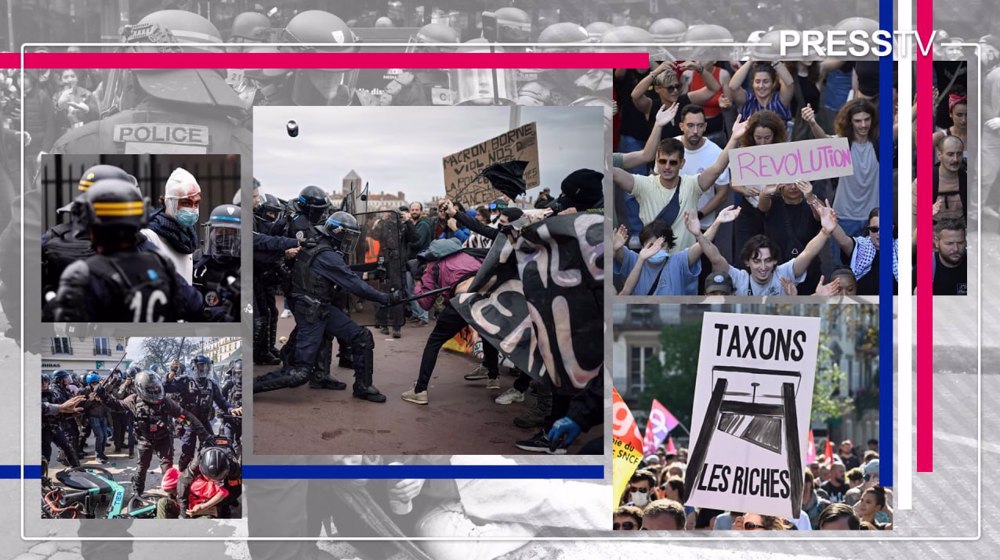
The student protests in France were sparked by the conditions of the students in the classrooms as well as the teachers' pay.
However, there are other factors behind the protests: social inequality and insufficient pay, which do not cover the expenses for the French standard of living, which, combined with the generous welfare that the French receive from the state, adds to the debt burden; a perfect recipe for a combustible economy.
France is on the verge of a debt snowball effect, where the growth of the interest burden outpaces what economic growth and inflation can absorb.
The French government needs to act immediately to stall the current economic crisis.
This article is based on an episode of the Press TV show, Economic Divide, featuring Mats Nilsson, Legal Historian and Political Analyst, as well as Georges Renard-Kuzmanovic, French Geopolitical Analyst.
France has the largest economy in the EU, so why is it enduring an economic crisis? Because the government has an unsustainable economic program loaded with problems like government spending.
France's debt-to-GDP ratio has been high for some time now, exceeding the EU limits. But the government continues down a path of borrowing and spending, which is why it has had sporadic bouts of protests. Budget cuts to try to rein in the crisis won't work when there are cuts, yet money gets spent elsewhere. The French won’t accept cuts, like in the case of students and education.
University students are demanding better housing assistance, affordable meals and protection of social benefits.
The protests began particularly strongly in poorer Paris Suburbs. Are these protests about inequality and the cost of living crisis?
"It goes deeper than the cost of living crisis and this is the feeling I have after having been with these young people these last weeks and during these protests."
"The students, the young people, the schools, they're expressing a profound feeling of inequality and they think that they have a world with declining opportunities."
Georges Renard-Kuzmanovic, French Geopolitical Analyst
- French student protests reflect deeper issues of inequality and wages that fail to meet living costs

"The most important thing is that this French educational system absolutely needs change."
"My daughter is in private school because the state schools around where we live in Paris are not equipped enough in teachers or equipment."
"It's not so bad, to be honest, but she's still in primary school."
"But the teachers are understaffed and unappreciated. That's really the thing. The role of the teacher in French society has dwindled."
French Parent 01
President Macron’s view on the violence:
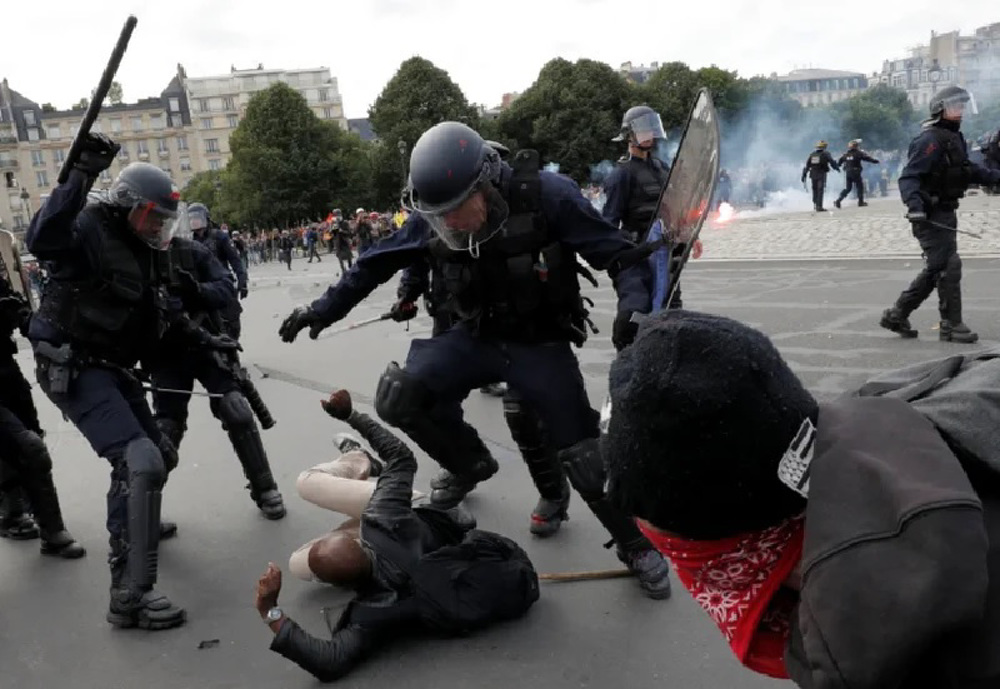
"Obviously, I will not condone or justify any kind of violence, and what we've seen among high school students, and among them, those who are no longer in high school, taking advantage of the situation to set fires, destroy property or engage in violence, is simply unacceptable."
French President, Emmanuel Macron
But how do the protestors feel about the situation?
"First of all, the resources in high schools and universities are in a terrible state. It's really a total mess. High schools are practically falling apart. There's no money left."
"There's the militarization of youth. And it's almost as if young people are being abandoned."
"And now we're just totally fed up because for years we've been speaking out about the lack of resources, but no one listened to us."
"So now we're here because this is the last resort to make ourselves heard. We see that some people are starting to say, yeah, all the young people, yeah, they're coming."
"They're starting to destroy everything, except that it's important to destroy things since we can't make ourselves heard peacefully."
"So this is the last means to make ourselves heard."
Student Protestor 01
The economic dimensions behind the student protests in France varied by period, but they generally reflected a deeper conflict over youth unemployment and insecure employment, inequality in access to education, tuition fees and the cost of living and opposition to labor market reforms.
But the central economic dimension of a student protest in France was the tension between the promise of equal opportunity through education and the reality of economic insecurity and social inequality.
"France is not yet Greece of 2010. France remains a very large economy with considerable assets still. And the French state continues nowadays to finance itself on the markets."
"So, but we have really a very serious debt problem and what concerns me the most is the speed in which this situation is deteriorating. That's the main issue."
"The public debt has now reached 3.6 trillion euros, which is almost 120% of our GDP."
"Since 2017, when President Emmanuel Macron was elected, this debt has increased by around 1.4 trillion euros, which is an insane amount."
Georges Renard-Kuzmanovic, French Geopolitical Analyst
"I have therefore chosen a rule that embodies an economic rationale, the long-term reduction of our country's debt with no turning back."
"We want every budget passed to progressively and sustainably reduce France's debt until it returns to a maximum level of 60% of GDP, in line with our international commitments, but above all, in the interest of sound management."
Marine Le Pen, French Presidential Candidate
Only one in three French people works in the real economy; two-thirds live, one way or another, off other people's taxes.
They won't vote for politicians who say France's absurd pensions and overblown state spending are unsustainable. They vote for those who promise to lower the already low retirement age even further.
That is the crux of the French problem.
Without drastically addressing the absurd debt-financed French pensions, France will not be able to avoid a debt crisis.
The French retire years sooner than other Europeans, and France is the only country where pensions exceed the income of the working-age population. France is Europe's next debt crisis epicenter.
Years of unrestrained spending, high taxes, and an unwelcoming business climate, combined with an aging population and surging interest rates, are creating the perfect storm.
France has not run a balanced budget since the 1970s, and debt to GDP sits at an uncomfortable 118 percent. Last year, the deficit was more than 5 percent of GDP.
France may face the next major crisis in Europe, and it is not just a matter of politics. France is now getting hit by a bond sell-off, exploding borrowing costs, fuel shortages, violent protests and foreign investors pulling money out.
France's 10-year yield briefly touched 5 percent, its highest level since 2002.
University students are demanding better housing assistance, affordable meals and protection of social benefits.
The protests began particularly strongly in poorer Paris Suburbs. Are these protests about inequality and the cost of living crisis?
"This is less of a classic cost-of-living protest than a structural inequality crisis expressed through the situation of education in France right now."
"The protests began in the poor Paris suburbs, and they were triggered by immediate material failures in the schools."
"Around 69-70 percent of French middle and high schools opened the 2026 school year with teacher shortages. And in these suburbs, roughly half of the teachers were absent on the first day."
"So that immediately prompted students to barricade the school entrances. Later, it's been proven that the deeper drive is this economic inequality."
"The students in low-income suburbs report dilapidated facilities and by that, I mean cockroaches, broken heating, overcrowded classrooms, while students in wealthier areas of Paris and France do not face the same conditions."
"The crisis is not universal across all French schools, but it is very severe in low-income areas."
"So this means that the movement that started out with the school protests have broadened, and it's now a national mobilization."
Mats Nilsson, Legal Historian and Political Analyst
The problems of France's economy are fourfold: firstly, stalled economic growth; secondly, a labor market that is weakening; thirdly, government debt and deficits are major constraints; and fourthly, political uncertainty, making the financial situation harder to manage.
Years of unrestrained spending, high taxes, and an unwelcoming business climate have created the perfect storm for France. The state spends nearly a third of France’s total economic output on social spending (healthcare, Pensions, and welfare payments).
Will France be the epicenter of Europe’s next debt crisis?
"France is not yet Greece in 2010, but France is, I would say, the weakest link in Europe's sovereign debt market. And the trajectory that it's showing is alarming."
"The 2025 deficit was around five percent of GDP; I believe that the 2026 forecast has been revised upwards to at least 5.4 percent, which is nearly double the EU's three percent threshold."
"So France, the nation of France has, for all intents and purposes, and looking at the numbers, has not run a balanced budget since 1974. What has changed is that the market has now perceived [sic] France as a liability."
"France's 10-year bond deal approached five percent in late 2026, which was the highest since the year 2021 or 2022; so French borrowing costs have actually exceeded those of Greece and Italy."
"The spread between France and German bonds has widened by a massive amount of points in a single week."
"So this is actually, from what I perceive and understand, this is the largest one-week move on the differential between the bonds in basis points since Bloomberg started tracking the data in 1990."
Mats Nilsson, Legal Historian and Political Analyst
According to the International Monetary Fund (IMF) in 2025, France was the world's 25th country by GDP per capita, with $48,981 per inhabitant.
Yet France's GDP per capita falls short of top OECD performers.
France recorded a government debt to GDP of minus 5.2 percent of the country's gross domestic product in 2026.
This is while the EU's deficit limit is only 3 percent.
Not only does this put the country's finances in danger, but it also qualifies France for an EU fine, which can also lead to the EU expelling France from the EU, something which the EU obviously will not do.
The French economy is not living up to the size of its GDP. The French government barely avoided a recession. Its economy grew only a meager 0.2 percent.
The Wall Street Journal says France's economy is trapped in a negative feedback loop. That uncertainty about whether the country can fix its finances has itself started to weigh in on economic activity.
Why has France not run a balanced budget since the 1970s? And why is its debt to GDP sitting at an uncomfortable 118 percent?
"Yeah, that's an extraordinary fact; France has not recorded a public surplus since 1974. So it's now more than 50 years."
"Governments from the left or the right, they have systematically spent more than the country produced. So that's, of course, that's a problem. But we need to distinguish here two periods."
First, for decades, France could live with moderate deficits because growth was strong and interest rates eventually became extremely low so debt became politically painless.
"Every government could postpone difficult decisions to the next one. That was the idea every five years."
"Then, when we had major crises, like the financial crisis in 2008, the COVID, then the energy crisis before the war in Ukraine, then the war in Ukraine, then now the war against Iran, which has consequences on the oil market."
"Well, all these crises obviously require exceptional expenditures."
"What is much more difficult to justify is what happened outside those exceptional periods."
Georges Renard-Kuzmanovic, French Geopolitical Analyst
One of the things that distinguish France from other countries is its welfare payouts.
When it comes to social spending, France has the highest among the OECD countries, coming in at 31 percent, well above the OECD average of 20 percent of GDP. This comes to roughly 10,000 euros per capita in purchasing power parity (PPP) terms.
France's budget has also been under scrutiny by lawmakers; reaching a consensus, however, is not an easy task. One of the things that it was not able to do was to freeze government spending in 2026.
The Treasury hopes to save 43.8 billion euros, but many doubt whether that will be achievable.
Then we have the issue of taxation, which is insufficient.
Gross salary is a little over 43,000 euros, while the employer cost comes in at 63,000 euros.
And finally comes government spending.
According to France's official budget directorate, we have 134.6 billion euros in planned budget deficit.
The amount by which the state's budget spending exceeds its net budget receipts on the relevant budgetary accounting basis it was allocated.
So far, it has spent a little over 168 billion euros
France has had years of unrestrained spending, high taxes and an unwelcoming business climate. Why has France not run a balanced budget since the 1970s?
"My short answer is that France chose a high-spending social model in the 1970s and never built the political consensus or the economic growth to pay for this social welfare model or the social French model."
"A slightly longer answer has a few more layers; social spending drift began in the late 1960s, and the state financed it through increased social contributions rather than taxes, thereby shifting the burden onto labor costs."
"And when the Mitterrand stimulus deepened deficits in the 80s, you suddenly had an austerity turn, which actually aimed for balance- sorry, it didn't really aim for the balance."
"How shall I put it? It merely set a target saying that it should be under 3 percent of GDP. But by the 1990s, that 3 percent ceiling had become a norm rather than a limit."
"So the psychological shift is that there has been a permanent deficit and it works. So what I'm saying is that the political situation has been that it's OK, and then that means that the voters have a feeling that it's OK."
"And any attempts to reform, for example, pensions, trigger mass protests."
"So there is a structural mismatch. Spending commitments grow automatically with demographics and inflation, while revenue grows only with economic activity."
"And France's economic growth has been a bit, you know, lackluster. Only 0.9 percent in 2025, a weakening tax base, and this is precisely when the demands on the states are rising."
"It's not really anything that's going to work out well; I would say the student protests are the social symptoms of the fiscal debt trap that France has put itself in."
"So, now there's a huge inability and the political fallout; whoever succeeds Macron will be tangible for the whole European Union area."
Mats Nilsson, Legal Historian and Political Analyst

The French far-right leader and presidential candidate Marine Le Pen has said: “I have therefore chosen a rule that embodies an economic rationale, the long-term reduction of our country's debt with no turning back. We want every budget passed to progressively and sustainably reduce France's debt until it returns to a maximum level of 60% of GDP, in line with our international commitments. But above all, in the interest of sound management, that's what needs to be done.”
Yet France's previous presidents have been unable to do so. The current government of France needs to take swift action before protests bring the government down.

 This makes it easy to access the Press TV website