

In Washington, wars are often declared won on the pages of mainstream media long before a single shot is fired.
Over the past few weeks, the US administration has orchestrated a deafening propaganda campaign, a highly engineered psychological operation with one singular objective: to convince the world, and more importantly, the Iranian people, that the Islamic Republic is on the brink of collapse.
Through a coordinated echo chamber of Western media outlets, the narrative being spun is that Iran is doomed, the tide has clearly turned in America's favor, and Tehran has no choice but to unconditionally surrender to Washington's demands.
"We have a war going on with a country that will never have a nuclear weapon and is ready to fold up; we will win very easily."
"Right now, they're just about, I believe, right after the election we will win, but maybe before the election."
US President Donald J. Trump
But beneath this manufactured bravado lies a starkly different geopolitical reality.
A sober strategic analysis of the battlefield, stripped of media spin, dismantles this psychological charade piece by piece.
The undeniable truth is that the United States is at a strategic dead end, and the Iranian nation is far too experienced and structurally resilient to be hoodwinked by Washington's hollow maneuvers.

Trump entered this war believing that military pressure would force Iran to surrender, but as the conflict continues, Washington faces a difficult choice: either to prolong a costly war or accept a settlement that falls short of its original demands.
The question now is whether Trump can end this war without admitting a strategic defeat.
To mask this impending reality, the White House's strategy currently rests on two crumbling pillars: an economic blockade and a military threat.
In the economic realm, the Trump administration claims to be strangling the Iranian economy through a policy of total economic exclusion.
They peddle a dual-strand narrative: first that Iran's economy is about to fall off a cliff, and second that the West is thriving, with oil flowing freely from the Persian Gulf.
"The Americans claim that Iran's economy had collapsed. It's true that we face economic challenges, but our economy has not collapsed."
"Iran's central bank is managing the rising exchange rate to a considerable extent, contrary to Trump's claims."
"Look at Iran's position in the region and internationally. It's very different from what it was before the war. There is absolutely no indication that Trump has won."
"Even members of the Republican Party do not believe he has emerged victorious."
Reza Saremi Rad, International Relations Expert
This is a complete distortion of the facts.
The calculations in Washington willfully ignore Iran's dynamic countermeasures and the vulnerability of the West's own economic house of cards.
While the United States inflicts undeniable pain through its sanctions, the notion that the West is escaping unscathed is a profound fallacy.
Look at the soaring inflation rates across Europe and the United States, the surging bond yields, and the crippling cost of diesel and mortgages; the Western economies are bleeding. Furthermore, the flow of oil is anything but secure.
The Iranian armed forces have fundamentally altered the energy equation with sophisticated new tactics.
Can we say that the US naval blockade of Iran can replace a military attack against the country and would actually compel Iran to surrender?
"When the US imposed a naval blockade, Iran responded by confronting them in the Strait of Hormuz.
Now, add the Bab al-Mandeb equation to that of the Strait of Hormuz, and maritime trade for countries around the world will face serious challenges."
"This will impose huge costs on them, including higher shipping insurance premiums."
"As insurance costs rise, transportation costs go up, and that, in turn, drives up fuel prices worldwide."
"Diesel prices in the United States have risen by 70 percent compared with last year"
"If this trend continues, can the US itself sustain the naval blockade?"
"Iran, on the other hand, has demonstrated considerable resilience in the face of all the threats and developments it has faced."
Omid Choupan Kareh, International Affairs Analyst

The Strait of Hormuz has become a major strategic lever for Iran. Its importance to global energy supplies gives Tehran significant leverage over Washington.
If reopening the waterway requires accepting Iran's demands, then the United States could find itself negotiating over terms it once sought to impose.
How has the Strait of Hormuz turned into a strategic lever for Iran with respect to the negotiations and the equations to end the war?
"Trump claims that the Strait of Hormuz has been reopened due to his efforts, with more oil passing through it than before the war."
"But that's not true; oil exports are not taking place on that scale, and to the extent that oil is passing through, some of it comes from our allies whom we allow to use that route."
"In practice, oil exports from Arab countries have fallen sharply to around 2 to 2.5 million barrels a day."
"Trump is constantly trying to portray developments as achievements for himself, hoping to use those supported victories as a way to exit the conflict."
Reza Saremi Rad, International Relations Expert
Beyond the Strait, the wider regional energy network is also under siege. With Yemeni Ansarullah forces actively targeting vulnerable Saudi pipelines and oil installations, the claim that energy markets are stable is a fragile illusion.
"When the war began, oil was trading at around 60 to 70 dollars a barrel. Now, despite their drawdowns from strategic reserves, prices are still averaging above 100 dollars a barrel, and this uptrend is likely to continue."
"There is simply no oil left in the market, and US reserves have reached rock-bottom levels. Prices are unlikely to come down."
"The storm in the Gulf of Mexico also forced the Americans to draw on another four million barrels from their reserves. All of this limits Washington's room for maneuver."
"On top of that, inflation has risen and bond yields have increased. Fuel prices in the United States have also surged, with gasoline up around 50 percent and diesel up 80 percent."
Reza Saremi Rad, International Relations Expert
The architects of this propaganda campaign also suffer from a profound historical amnesia. History offers not a single example of a major nation surrendering solely due to an economic blockade.
Even in World War I, it was the catastrophic loss of life in the grueling ground wars on the Eastern and Western Fronts, not just the naval blockade, that finally brought Germany to its knees.
Today there is no viable ground war against Iran, nor is there a functioning air campaign.
The notion that economic pressure alone will break the will of a nation that has thrived under severe sanctions for over four decades is a catastrophic miscalculation.
"It is not even clear whether Trump has been able to define his objectives because his strategy keeps changing and being scaled back."
"Initially he was seeking regime change in Iran, but now he has settled for reopening the Strait of Hormuz. He is also making other claims, such as demanding control over oil. But his ambitions have continued to shrink."
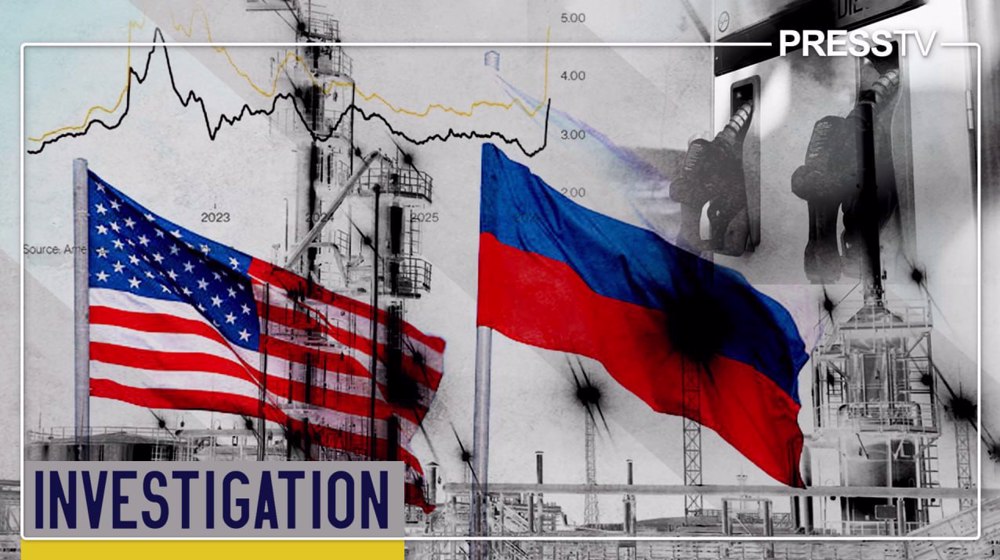
"Now, in a bid to improve his chances in the Senate elections, he has turned to Putin and asked him to export diesel to the United States."
Reza Saremi Rad, International Relations Expert
Can a naval blockade succeed where military forces failed? Sustaining such a campaign requires enormous resources and could take months or years. Rather than forcing Iran to surrender, the blockade could deepen America's predicament and prolong the war.
This predicament is magnified when considering the nature of the threat against Tehran. When the President of the United States repeatedly issues existential threats, speaking of wiping Iran off the map, the geopolitical equation shifts entirely; you do not surrender to an existential threat, you fight to the absolute end.
The Islamic Republic of Iran is fighting for its sovereignty, survival, and civilizational dignity. And if Washington's hawkish strategies actually succeed in pushing Iran to the edge of the abyss, they will trigger the very catastrophic second strike capability that the Pentagon fears most.
"It has become clear that the United States and Israel are facing the prospect of collapse, and they're now carrying out an extensive media campaign to conceal this reality."
"Trump makes new promises every day. The latest figure I have is that he has told more than 560 lies, which is unprecedented worldwide."
"One day he claims the Strait of Hormuz is under his control, but the very next day, we prove otherwise."
"He also claims he will ensure the security of shipping for the southern Persian Gulf states."
"He has failed to do so and will never be able to, because we have the greatest geopolitical control over the Strait of Hormuz, both at the entrance of the Persian Gulf and in the Gulf of Oman".
Brigadier General Hassan Rastgar Panah, Center for Sustainable Security Strategic Studies
Tehran holds a retaliatory trump card; if pushed to the doomsday option, Iran has the undeniable capacity to decimate the energy infrastructure across the entire Persian Gulf.
Beyond oil terminals, the vital desalination plants that sustain the very existence of countries like Saudi Arabia and the Zionist regime are well within the crosshairs of Iran's precision missile and drone arsenals.
Laying waste to these facilities would not just cripple regional states but would also send the global economy into a catastrophic tailspin. Iran's active deterrence is the ultimate red line. American military planners know that their sprawling regional infrastructure is now entirely at the mercy of Iranian precision.
"What we'd been doing up to this point was strengthening our deterrence capabilities. Our advances in missile systems were aimed at deterrence, while our progress in drones and other military capabilities served the same purpose."
"All of these developments were defensive in nature, but the enemy made a serious miscalculation."
"It intended to bring about the collapse of the Islamic Republic within three days; instead, those three days led to the Ramadan war in which the two sides fought directly for more than 40 consecutive nights. That conflict has continued to this day."
Brigadier General Hassan Rastgar Panah, Center for Sustainable Security Strategic Studies
This war has exposed the vulnerability of US military bases in the Persian Gulf.
Iran's missile capabilities have raised serious questions about their value as security guarantees.
Rebuilding these installations may be possible, but restoring deterrence and regional trust could prove far more difficult.

"They assumed that deploying THAAD air defense systems in the UAE or Qatar would leave them completely safe from Iranian missiles and drones and that they would face no serious threats."
"But we have repeatedly seen Iranian missiles and drones easily penetrate American and Israeli radar systems and strike US military bases across the region. This shattered the myth of American military superiority."
Omid Choupan Kareh, International Affairs Analyst
Indeed, this loss of deterrence means Washington is not facing an isolated nation, but an integrated, highly motivated regional alliance.
The resistance axis has effectively expanded the battlefield across multiple geographic nodes, transforming a bilateral standoff into a complex, multi-front war of attrition.
From the Red Sea to the Levant, American assets are perpetually outmaneuvered by asymmetrical tactics.
"The Americans never expected us to have the ability to respond so decisively, swiftly, accurately."
"Our martyred leader had already warned that if they committed an act of aggression, the war would no longer be between us and them, it would become a regional war, and the criminal United States would have to answer for its actions."
"We saw that in the first 10 days alone, hundreds of billions of dollars they had spent on military assets in the southern Persian Gulf went up in smoke."
Brigadier General Hassan Rastgar Panah, Center for Sustainable Security Strategic Studies
And then there is the direct military threat.
The administration proudly boasts of deploying an additional 10,000 troops and heavily implies the presence of an overwhelming armada of three aircraft carriers in the region. It is a masterful piece of theatrical deception.
Independent naval tracking confirms that the USS George H.W. Bush has long left the region, and the incoming USS Theodore Roosevelt is merely replacing the USS George Washington. There is only one active carrier in the region, and the exhausted US Navy, stretched to its absolute operational limits, cannot sustain a prolonged multi-carrier presence.
Relying on logistical lifelines stretched over 2,500 miles from Diego Garcia makes a sustained air campaign physically impossible, especially considering the severe munitions crisis currently plaguing the US military.
"The leader of the Islamic Revolution of Iran, Ayatollah Seyed Mojtaba Khamenei, drew a clear red line, declaring that the Strait of Hormuz belongs to us and that Iran determines how traffic through this waterway is managed and regulated."
"The Americans then tried to pull a stunt by imposing a blockade in an initial perimeter in the Gulf of Oman. When they realized that they were vulnerable, they extended its range and pushed it further away."
"Yet they still claim to control the Strait of Hormuz, which is completely meaningless."
Brigadier General Hassan Rastgar Panah, Center for Sustainable Security Strategic Studies
The crowning absurdity of Washington's propaganda is the veiled threat of a ground invasion. Media outlets breathlessly report on a combined force of 60,000 American troops in the region.
But wars are not fought by cooks, mechanics, and ship personnel. A strictly military breakdown reveals that out of those 60,000, there are at most 7,500 actual combat troops.
To put this farce into perspective, military experts estimate that seizing and holding just the Strait of Hormuz would require a minimum of 150,000 combat troops fighting a grueling war for months.
If an army of nearly 200,000 Russian troops faced formidable challenges in the geography of Ukraine, how does the Pentagon plan to invade a mountainous, impenetrable nation of over 85 million people with a force one-tenth of the required size?

"Following the third imposed war on Iran, we have now reached the point of no return, the end of the US military presence in the region."
"This war marked a turning point that will accelerate America's withdrawal from the region, and we are already seeing signs of it."
"The fact that US forces have withdrawn from Iraq shows that the Americans, too, have realized their era of military presence in the region is over."
Omid Choupan Kareh, International Affairs Analyst
The bottom line is undeniable: this propaganda campaign is a colossal failure born of desperation.
You cannot bring a formidable regional superpower to its knees with an exhausted Navy, a critical shortage of munitions, and a fraction of the necessary ground forces.
The realities on the ground tell a different story from what US propaganda claims as Iran's imminent defeat. Why is there such a discrepancy?
"The point is that despite the political, military, and security costs, Trump has failed to achieve any clear political gains."
"He keeps boasting about the military victory and portrays himself as the winner on his social media platform, but this is nothing more than a claim."
"You cannot win a battle simply by claiming victory. There is a huge gap between declaring victory and achieving a real victory on the battlefield."
Omid Choupan Kareh, International Affairs Analyst
The Islamic Republic of Iran cannot be bamboozled.
The Iranian leadership and its people are far too knowledgeable, resilient, and strategically astute to fall for the deceptive tactics of American imperialism.
They recognize this grandstanding for exactly what it is: the desperate thrashing of a declining superpower.
Iran stands unbowed, holding the strategic upper hand, and no amount of media engineering will ever force it to surrender

 This makes it easy to access the Press TV website