
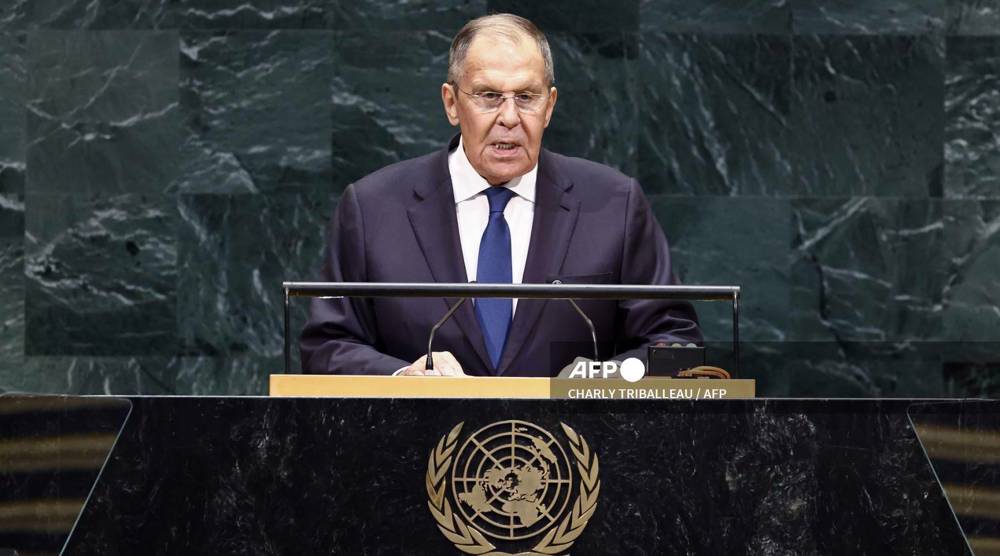
Russian Foreign Minister Sergei Lavrov says the assassination of Leader of the Islamic Revolution Ayatollah Seyyed Ali Khamenei was “another unacceptable manifestation of coercive diktat.”
Addressing the General Debate of the 81st session of the United Nations General Assembly in New York on Saturday, Lavrov denounced the assassination of members of Ayatollah Khamenei’s family, as well as Iranian military and political officials.
He said the use of force to kill Ayatollah Khamenei and members of his family was “unacceptable,” while condemning the broader US-Israeli aggression against Iran.
Lavrov added that the US-Israeli aggression had targeted not only Iran’s civilian infrastructure but also peaceful nuclear facilities operating under International Atomic Energy Agency (IAEA) safeguards.
He noted that the attacks on the safeguarded nuclear facilities in Iran had caused “irreparable damage” to the international nuclear non-proliferation system overseen by the UN-backed nuclear energy watchdog.

The United States and Israel launched the illegal war of aggression on February 28 by assassinating Ayatollah Khamenei along with top commanders and massive bombardment of Iranian infrastructure.
Iran’s response was resolute. The Islamic Republic wielded firm control over the strategic Strait of Hormuz and forced the aggressors into a retreat, entirely upending Washington’s calculations for “regime change.”
In June 2025, the United States bombed three Iranian nuclear facilities in Fordow, Natanz, and Isfahan, in a clear violation of international law and the Nuclear Non-Proliferation Treaty (NPT).
The US and Israel attacked Iran while nuclear negotiations were underway, using the talks as a cover for aggression under the illusion that the attack would eliminate Iran's nuclear program and eventually topple the Islamic Republic.
Russia's permanent representative to international organizations in Vienna, Mikhail Ulyanov, said on Thursday that the return of the IAEA inspectors to Iran is not possible amid continued US threats against the country.
He added that the United States has never provided guarantees that it will halt missile attacks on Iranian territory, saying, “On the contrary, they are practically issuing threats every day, and sometimes several times a day."
Turning to the Strait of Hormuz, Lavrov said Russia had launched an initiative to establish peace in the Persian Gulf region and help resolve the crisis over the strategic waterway.
The top Russian diplomat warned that repeated armed clashes in the Persian Gulf and the Strait of Hormuz continue to undermine global navigation and trade.
He stressed the importance of building trust among Persian Gulf states, Arab countries and Iran to resolve the crisis.
Lavrov said Russia, together with other countries, was “ready to contribute constructively to stabilizing the strategically important Middle East region.”
Elsewhere in his address, the Russian foreign minister said the time had come to resolve the region’s main problem — ensuring the statehood of the Palestinian people.
He said the UN Security Council approved a peace plan for the Gaza Strip almost a year ago, but peace has yet to be achieved, while the humanitarian situation remains critical.
Lavrov added that Israel was expanding settlement activity in the West Bank.
 This makes it easy to access the Press TV website