
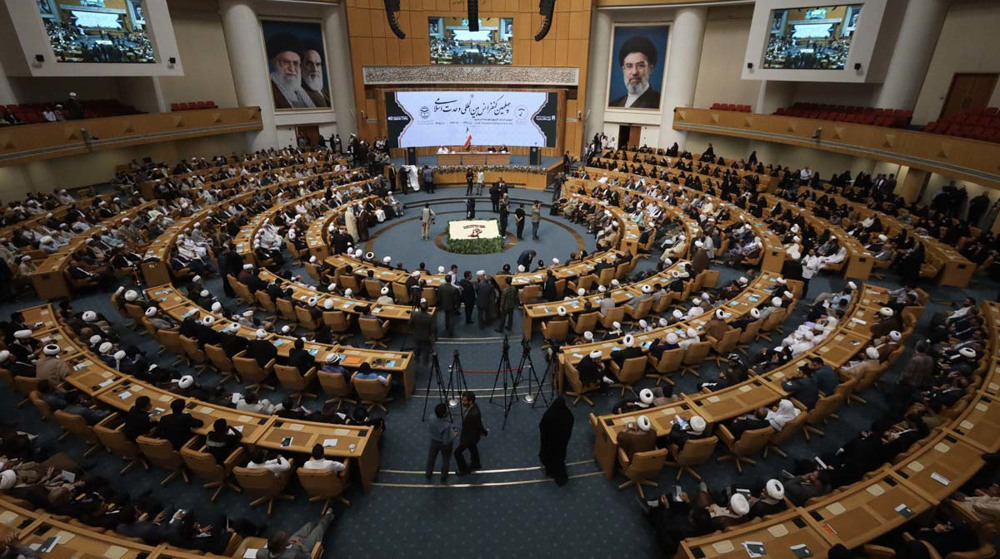
The 40th International Conference on Islamic Unity kicks off in Tehran with a focus on the martyred Leader of the Islamic Revolution Ayatollah Seyyed Ali Khamenei's vision for strengthening unity across the Muslim world.
The conference opened on Thursday with the participation of Iranian President Masoud Pezeshkian and hundreds of Muslim scholars and thinkers from some 40 countries.
Nearly 600 domestic and foreign guests, including prominent academic, cultural and religious figures from Muslim countries,including Iraq, Pakistan, Turkey, Lebanon, Afghanistan and the Persian Gulf states, as well as a number of ambassadors based in Tehran attended the opening ceremony.
The event is being held under the theme “Islamic Unity in the Thought of the Martyred Imam, Ayatollah Seyyed Ali Hosseini Khamenei.”
It seeks to create unity and cohesion among Muslims, promote synergy among religious scholars and thinkers, and help bridge scientific and cultural perspectives across the Muslim world.

'Simplistic' to think that US-Israeli hostility only targets Iran: Senior cleric
In a message to the conference, senior Iranian cleric Ayatollah Hossein Noori Hamedani said Muslim unity had been essential throughout Islamic history, but its importance was even greater today as Islam’s enemies were seeking to weaken Muslims, sow divisions and establish control over Muslim countries.
“Today, when the enemies of Islam are using all their capabilities to weaken Muslims, create divisions and dominate Islamic countries, this issue has taken on even greater importance,” Ayatollah Noori Hamedani said, adding that “the rational necessity and religious obligation” of unity were more evident than ever.
“The Holy Qur’an calls on Muslims to hold fast to the rope of God and explicitly prohibits the disputes and divisions that lead to the weakening and loss of their power and glory,” he said.
“Proximity and unity do not mean that followers of Islamic schools should give up their principles and beliefs,” he said. “Scholarly differences must remain within the realm of scholarship and research and must not become a means for conflict, hostility, declaring Muslims infidels and the shedding of Muslim blood.”
He said Islamic scholars had a major responsibility in this regard and should prevent religious differences from being exploited by Islam’s enemies.
Ayatollah Noori Hamedani said the United States and Israel were at the forefront of those seeking to weaken Muslim countries.
“Today, the enemies of Islam, led by the United States and the Zionist regime, want nothing but the weakness, division and backwardness of Muslims,” he said.
He called it “naive” to believe that Washington and Israel were pursuing separate objectives. “It is naive to think that these two forces are independent of one another and pursuing different goals,” he said. “The experience of recent years has clearly shown that their goal is to dominate the region and prevent Islamic countries from becoming powerful.”
Ayatollah Noori Hamedani also rejected the notion that the United States and Israel’s hostility was directed solely at Iran. “To think that their hostility is only toward the Islamic Republic of Iran is an extremely simplistic view,” he said.

He urged regional governments to recognize Israel’s broader opposition to powerful and independent Muslim countries. “Regional rulers should know that the Zionist regime will have a problem with any powerful Islamic country that wants to stand on its own feet, live independently and refuse to submit to foreign domination,” he said.
“Today, the Islamic Republic of Iran is the target of their hostility, and tomorrow, any other Islamic country that moves toward independence and strength could become the target of the same hostility,” he added.
The senior cleric stressed the need for Muslim unity and an end to division, particularly under current circumstances. “Unity and avoiding disagreement and division, have always been a rational necessity and a religious obligation, particularly under the current circumstances,” he said. “Any word or action that causes Muslims to become separated from one another is undoubtedly serving the desires of the enemies of the Muslim community.”
Participants in the conference are expected to examine practical approaches for advancing Islamic unity, strengthening the concept of a united Muslim community, and settling challenges facing Muslim nations.
For Shia Muslims, the 17th day of Rabi al-Awwal — which falls on Aug. 30 this year — commemorates the birth anniversary of Prophet Mohammad (PBUH). Sunni Muslims, meanwhile, mark the occasion on the 12th day of the Islamic month, Aug. 25 this year.
The period between the two dates has been observed as Islamic Unity Week since the 1980s, following a declaration by Imam Khomeini, the founder of the Islamic Republic of Iran.
 This makes it easy to access the Press TV website