
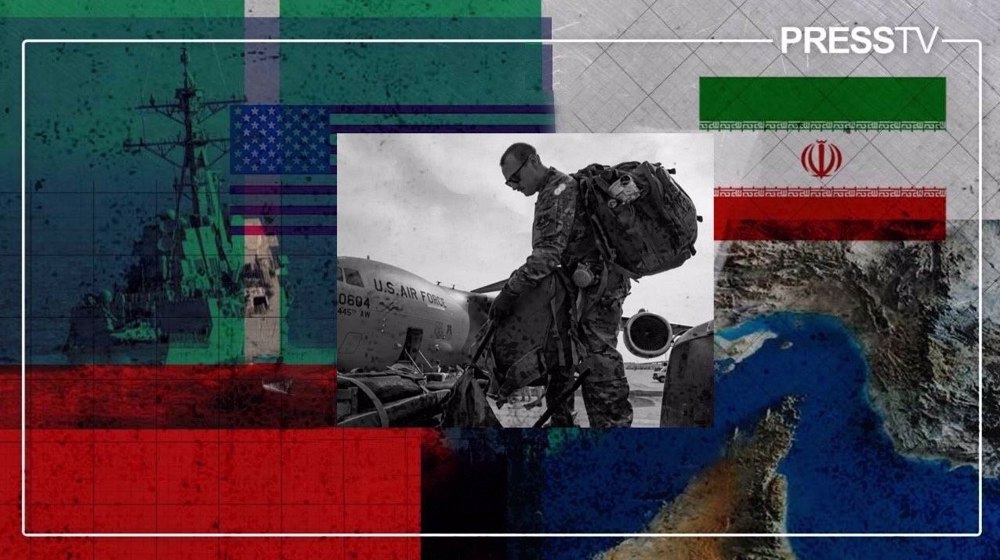
Iran’s sustained retaliatory strikes against US military positions across West Asia have exposed the vulnerability of Washington’s military footprint in the region, prompting the Pentagon to examine whether the American presence in the Persian Gulf should be scaled back after the war on Iran, according to a report.
The Washington Post reported on Tuesday, citing eight people familiar with the matter, that the Pentagon’s policy office is conducting an initial assessment of the future of the US military footprint in West Asia.
The review is examining whether bases damaged by Iranian missile and drone strikes should be rebuilt in their previous form or whether Washington should use the destruction to establish a smaller military presence.
The assessment is not yet a formal review ordered by War Secretary Pete Hegseth, according to a senior Pentagon official cited by the Post, who described it as “prudent planning” that could eventually inform decisions on the future of US forces in the region.
The newspaper said the damage inflicted by Iranian missile and drone strikes has given some US officials an opportunity to reconsider Washington’s long-standing military footprint in West Asia.
More than 200 US military facilities have reportedly been damaged or destroyed, according to the Post, while six US service members were killed in a March Iranian strike on Port Shuaiba, a military facility in Kuwait.
The damage has also forced the Pentagon to confront a vulnerability that has long been a concern for US forces in the region, the concentration of troops, aircraft and military infrastructure at bases within range of Iran’s missile and drone capabilities.
US Central Command (CENTCOM), which oversees American military in the region, normally has around 40,000 troops stationed across nearly 20 sites stretching from Jordan and Oman.
Before the war began in February, CENTCOM had already begun moving personnel away from some bases before the war, after determining that they were too vulnerable to Iranian attacks, the Post reported. Some of those changes could remain in place after the war ends, it added.
Among the options under discussion is relocating troops and military equipment to Jordan, Israel and Saudi Arabia’s Red Sea coast. Michael Ratney, a former US ambassador to Saudi Arabia, told the Post that the war had demonstrated the vulnerability of American forces in the region and backed shifting some assets farther west, while acknowledging that such a move would not remove the threat.
Any reduction in US troops would also force Washington’s Persian Gulf allies to reconsider their longstanding reliance on American protection. The Post said a smaller US footprint could push regional states to invest more heavily in their own defense capabilities or seek security arrangements with other powers.
At the same time, the possible drawdown could deepen an ongoing debate within the Trump administration over the scope of US military involvement overseas. Some officials favor pulling back from Washington’s extensive overseas military deployments and concentrating resources on homeland defense and major strategic rivals such as China, while interventionist voices continue to push for maintaining a large US military presence in West Asia.
The strain extends beyond US bases and personnel. The US military has also used more than 1,000 advanced air-defense interceptors during the war, further depleting Pentagon stockpiles of Patriot and Terminal High Altitude Area Defense (THAAD) missiles, according to the report.
The Pentagon has estimated that the US war on Iran will cost around $37.5 billion through the end of September, although that figure does not include the cost of rebuilding damaged military bases.
US Defense Department has not yet determined how much reconstruction would cost or how extensively the bases should be rebuilt. Meanwhile, an American Enterprise Institute estimate in April put the cost of repairing targeted US bases in the region at about $5 billion.
Trump recently acknowledged serious shortages in American military stockpiles, while reports have also revealed that the US has depleted significant portions of its advanced munitions stockpiles after five months of military operations against the Islamic Republic of Iran.
Analysts have long maintained that the US-led aggression has only strengthened the Islamic Republic’s defensive posture while exposing vulnerabilities in the American war machine.
 This makes it easy to access the Press TV website