Iranian technologists develop automotive nanocatalyst to reduce vehicle emissions

Iranian technologists have developed an automotive nanocatalyst designed to reduce harmful pollutants emitted by gasoline- and gas-powered vehicles, offering a locally developed solution to help curb air pollution in cities.
The nanocatalyst has been developed by an Iranian tech company following years of research and development.
By optimizing the use of precious metals used in the catalyst while maintaining its performance, the technology can reduce production costs without compromising its ability to control vehicle emissions.
The company is the first Iranian manufacturer of catalysts used in gasoline- and gas-powered passenger cars and the country’s only producer of catalytic converters for motorcycles.
Babak Shemshadi, the company’s head of research and development, says the company began its activities in automotive catalyst production in 2004 and entered industrial-scale production in 2007.
“Today, the company is considered one of the major automotive catalyst manufacturers in Iran, and its products are used in domestically manufactured vehicles as well as foreign and Chinese cars,” Shamshadi was quoted as saying by Fars News Agency.
Automotive catalysts are installed in the vehicle’s exhaust system to reduce gaseous pollutants produced during fuel combustion.
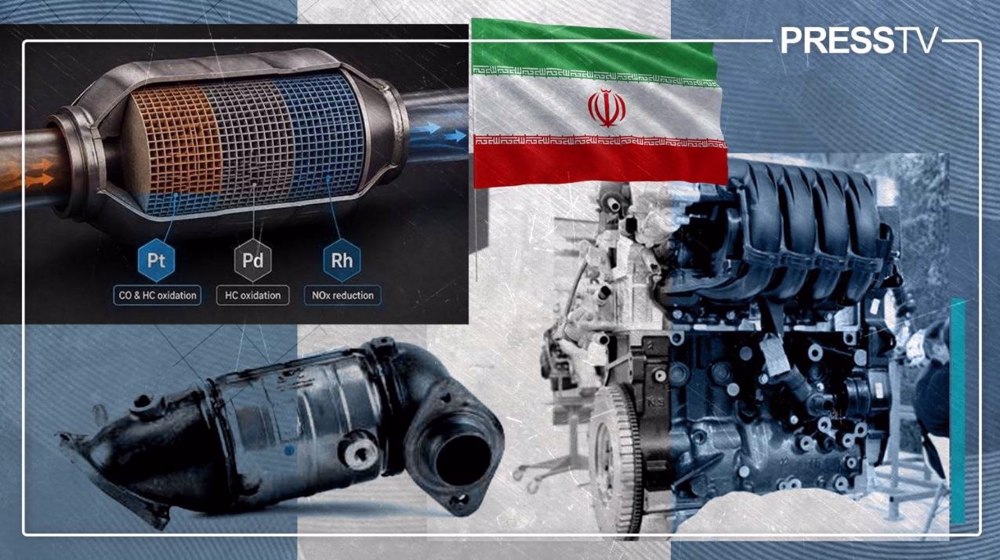
In three-way catalytic converters, three major pollutants – carbon monoxide (CO), unburned hydrocarbons (HC), and nitrogen oxides (NOx) – are converted through catalytic reactions into less harmful compounds, mainly carbon dioxide (CO₂), water (H₂O), and nitrogen (N₂).
The nanocatalyst is placed along the vehicle’s exhaust path, where it triggers oxidation and reduction reactions that transform harmful compounds in exhaust gases into less hazardous substances.
✍️ Feature - Iran’s indigenous TU5 nanocatalyst cuts precious-metal dependence, saves $500,000 per batch
— Iran First (@IranFirst_PTV) August 16, 2026
By Ivan Kesic#IranFirsthttps://t.co/78bAPtVwY7
According to Shemshadi, the catalysts are mainly composed of a porous catalytic support such as alumina (Al₂O₃), along with active precious metals including palladium (Pd), platinum (Pt), and rhodium (Rh).
“The active catalytic components used in the structure of the product are at the nanoscale,” he said, adding that the product has received nanoscale certification from Iran’s National Nano and Micro Technology Development Staff.
The company currently has a production capacity of around 5,000 units per day, with its products manufactured in accordance with Euro 5 emissions standards. The company’s customers include automotive engine manufacturers.
Shemshadi said the technology is based on optimizing the catalyst’s formulation and structure and making more efficient use of platinum, palladium and rhodium.
“The advantage of this product is that, through the optimized use of precious metals and the nanostructured design of the catalyst, it can achieve the desired performance with smaller amounts of costly materials,” he said.
“This allows us to reduce production costs while maintaining the quality and ability of the catalyst to reduce emissions.”
The company initially produced the catalyst in accordance with Euro 2 emissions standards, while its current products meet Euro 5 requirements.
Development of technology for Euro 6-compliant catalysts is also underway.
The nanocatalyst is designed to help reduce air pollution by converting harmful pollutants in vehicle exhaust into less hazardous compounds, providing a technological solution for controlling emissions from road vehicles.
Iranian knowledge-based company develops nanofilters to reduce power plant energy consumption

Iranian stem cell specialists save 2,000 children suffering from life-threatening diseases

Iran unveils second homegrown antivirus to counter malware and cyberattacks



VIDEO | Iraq’s fuel crisis deepens amid supply disruptions
US tested Lockheed cluster missiles on Iranian civilians, Baghaei says
Iran, Oman jointly postpone Persian Gulf foreign ministers’ meeting
VIDEO | Gaza’s women: The sole providers of families shattered by war
VIDEO | News Review: Trump’s comments on Irish unification spark backlash among his British allies
VIDEO | Press TV's news headlines
Yemen reports 58 Saudi attacks in one day, vows decisive response
VIDEO | US failed economic policy on Iran




 PressTV NEWSLETTER
now
PressTV NEWSLETTER
now
 This makes it easy to access the Press TV website
